Aug 7, 2006

Liturgical Resources At Archive.org

I recently was introduced to an excellent site: The Internet Archive, by way of the blog in illo tempore (biretta tip to Mike). I found the following goodies available there:


There's quite a bit of other vintage liturgical and Catholic treasures to be had so poke around a little - you'll be pleasantly surprised, I know that I was.

Aug 1, 2006

O bone Iesu, fac ut sacerdos fiam secundum Cor tuum.

O good Jesus, grant that I may become a priest after Thine own Heart.
I wish to share my joy with all who read this blog or perhaps will have only just happened upon it by accident, and also to implore you for your prayers on my behalf, that I have been recently accepted as a seminarian for the Diocese of Phoenix by His Excellency, Bishop Thomas Olmstead. I will be attending the Pontificium Collegium Josephinum in Columbus, Ohio beginning the end of this month. I desire to thank all those, some of whom are readers of this blog, who encouraged me in my process of discerment up to this point either through their words to me, example of Christian virtues, and through prayers for vocations in general or for mine in particular.

Jul 20, 2006

Praying In Latin

My first real contact with the Latin language coincided with the death of my grandfather in 2003. My grandmother gave me a veritable library of books which included several on the liturgy most of which have been quoted on this site. A little over a year later I attended the first Classical Roman Rite Mass in my diocese that had been offered in communion with the Bishop in 35 years. Between the time of my grandfathers death and my first experience of the Classical Rite I had learned to pray the Rosary in Latin. I learned from a variety of sources beginning with the Our Father which I learned to chant from Pope John Paul II's album Abba Pater. This was also my first experience of Gregorian Chant. I will have to admit to mispronouncing several words of the Our Father and Hail Mary for some months before finding audio files to practice with. Even then I found that some pronounced words differently than I had heard them. Eventually I was instructed in Latin by a parishoner of the Mater Misericordiae Latin Mass community. Over time I acquired a Lewis and Short Latin Dictionary, a Wheelock's Latin course book, and several other teach-yourself courses. Attending the Latin Mass and listening to Gregorian Chant CD's really helped me along. While I am certainly not fluent in Latin, it has become my preferred language for prayer. I find that praying in Latin has had several benefits. First and foremost, it helps me to collect myself and become orientated towards God. Secondly when I first began praying in Latin it helped me to learn the prayers again and to become more familiar with the meaning of the words that I had so often rattled off in English. Thirdly, the natural rythmn of the Latin once become familiar is an anchor that leads me to contemplation and recalls me to my task when my focus shifts. The same but twice over for Gregorian Chant which effortlessly places me in the presence of God even when the schola is chanting an Offertory with which I am by no means familiar. Last night, I was reading Directorium Asceticum; or Guide to the Spiritual Life by Fr. John Baptist Scaramelli, S.J. and I came across this passage:


Volume I, Chapter VI: Three Sorts of Attention Suitable in Prayer.


"260. St. Thomas says that the attention which we have in our vocal prayers is threefold.1 The first kind is that which we pay to the words, as in the recitation of the Divine Office, during which we are bound to read the words carefully, and to pronounce them distinctly, so as to avoid making mistakes in the exact pronunciation of the prescribed words. But that this attention may be of real advantage, the person must have begun by placing himself in God's presence with the purpose to pray by the recital of this particular form of prayer. The second kind of attention is that paid to the meaning of the words uttered, as when those reciting the Psalms, the Our Father, Hail Mary, or other like prayers, all of which abound with devout affections, reflect meanwhile on the sense of what they say, and unite to the verbal recitation the devout feelings of their hearts. If the person making use of such prayer, instead of going always forward - as is done when reciting the Canonical Hours - prefer to stop at every verse and make devout reflections, nourishing his mind with the various meanings which occur; then the prayer will be something more than merely vocal; it will be mingled with Mental Prayer, and may be styled (to use the expression of St. Ignatius in his Spiritual Exercises) the "Second Method" of prayer. The third kind of attention is that given not to the words merely, nor to their import only, but to God Himself, to Whom all prayer is addressed directly or indirectly, as when, in prayer, we keep ourselves recollected in the presence of God, and adore, love, and thank Him, or entreat Him in our hearts to grant us the graces of which He sees us to stand in need. The first sort of attention [to the words] suffices; the second [to the import] is good, and may be very profitable; the third is best, and may become most advantageous to such as earnestly apply it. And we may here observe, that St. Thomas calls this last-mentioned application of the mind most necessary, especially to such as by their ignorance of the Latin language are unable to enter into the sense of the Psalms, the Pater Noster, or other prayers approved by Holy Church;2 for thus, while with their tongues they recite words which they understand not, instead of allowing their thoughts to wander in every direction, they can and should fix their minds on God, and occupy themselves with devout and profitable affections.

261. There is a well-known instance of this in the Chronicles of the Cistercian Choir. St. Bernard, while at choir one night with his monks, had the following vision: He beheld, by the side of each of the religious, an Angel with pen and paper in hand,taking down every psalm, verse, and word that was recited. There was this difference, nevertheless, that some Angels wrote in letters of gold, others of silver; others again used ink, others dipped their pens in water; while some stood holding their pens in their hands, without taking down anything. While the Saint was beholding this spectacle with the eyes of his body, God Almighty opened those of his mind, and, by a ray of heavenly light, caused him to seize the true meaning of this vision. He now understood that the letters of gold signified fervour of spirit, the inward charity that animated the prayers of some; those of silver denoted devotion, sincere in itself, but joined with a less degree of fervour. The letters in ink indicated the scrupulous exactness wherewith some recited the words of the psalms, but with very little devotional feeling. The prayers written with water indicated the negligence of such as, overcome with drowsiness, indolence, or idle thoughts, did not give careful attention to what they were reciting with their tongue. The Angels who wrote nothing represented the indolence and malice of those who were asleep or voluntarily distracted. We may gather from this legend that our Guardian Angels will write down our vocal prayers in divers characters, according to the measure of the attention, fervour, and devotion with which we pronounce the words.

262. But the reader may wish to know who takes note of the prayers which the Angels do not register, and whether they are wholly forgotten, and left both unrewarded and unpunished. I may direct them for an answer to another vision, from which it appears that such prayers are written by the demons in dark characters, indicative of the severe punishement in store.3 A holy Priest, after having celebrated Mass for the people, beheld standing by the altar, a demon, who, with pen and large skin of parchment in hand, was busily writing. The servant of God, without feeling any fear, commanded him, in the name of Jesus Christ, to show what he was so carefully noting down. The fiend replied, 'I am taking note of all the sins committed by the people while assisting at Mass.' Upon this the Priest, with a courage befitting his calling, snatched the long scroll from the enemy's hands, and read out before all the people the list of the faults each one had committed that morning at Mass. On hearing themselves publicly convicted of all the acts of immodesty and irreverence of which they had been guilty in Church, in time of prayer and during the Holy Sacrifice, they conceived a great sorrow, and hastened to confess with sincere contrition. When the Confessions were concluded, all trace of the infernal handwriting had vanished from the parchment; a sure token of the pardon God had granted. We shall then do well, when we begin to say our beads, the Office, or other pious prayers, to figure to ourselves our Guardian Angel standing on one side ready to note down our prayer in the Book of Life, if it be worthy of reward; and on the other side, the devil ready to mark it in the Book of Death, if it deserve punishment. And that we may gain merit and not incur chastisements from our prayers, I will say with St. Cyprian: 'When we are at prayer, dearly beloved, let us be watchful and apply ourselves with all the earnestness of our hearts. Far from us, at that time, be every worldly and carnal thought. The mind should then be intent upon nothing save upon the matter of our prayer alone.'4 The same holy martyr proceeds to inculcate such attention by the words of the Priest, who, at the Preface of the Mass, says to the people, 'Lift up your hearts:' to which all used to reply, 'We have them lifted up to the Lord.' Whereby we are reminded that in time of prayer, our thoughts must be wholly fixed on God alone.5

263. It must be borne in mind, however, that what has hitherto been said applies only to wilful distractions either purposely sought for the sake of amusement, or admitted with advertence; whether these proceed from the inconstancy of our fancy, or from the suggestions of the enemy of all good. Distractions such as these are alone sinful, St. Thomas teaches, and alone deprive our prayer of all fruit.6 But in no sense do I allude to those involuntary wanderings which may happen to any pious person qutie against his will, when, in placing himself transported elsewhere by importunate imaginings; provided these be driven away directly, and the sense of God's presence be renewed. Such distractions, as we learn from the same holy Doctor, though they return a hundred times, are by no means incompatible with true prayer.7 Nay, he further adds, for the encouragement of certain timorous consciences, that even persons raised to the highest pitch of contemplation, are, at times, borne down by human frailty to thoughts of earth, by the involuntary wanderings of the mind.8 Those, then, who are in earnest about their spiritual progress, must in time of vocal prayer keep strict guard over their minds and hearts, and they must take heed not deliberately to admit any thought foreign to prayer. When they do this, they need be under no alarm that their petitions will be advantageous to themselves and very pleasing to God."


1 Dicendum, quod triplex est attentio, quae orationi vocali potest adhiberi: una quidem, qua attenditur ad verba, ne aliquis in eist erret. Secunda, qua attenditur ad sensum verborum. Tertia qua attenditur ad finem orationis, scilicet ad Deum, et ad rem pro qua oratur. 2,2 quaest. 83, art. 3. in corp.

2 Quae quidem est maxime necessaria:et hanc etiam possunt habere idiotae. Ibid.

3 Joan.Junior. In lib. Scala Coeli.

4 Quando stamus ad orationem, fratres dilectissimi, vigilare, et incumbere ad preces toto corde debemus. Cogitatio omnis saecularis, et carnalis abscedat, nec quidquam tunc animus quam id solum cogitet, quod precatur. De. Oration. Dom., Serm. 6.

5 Ideo et sacerdos ante orationem, praefatione praemissa, parat fratrum mentes, dicendo: Surusm corda; ut dum respondet plebs: Habemus ad Dominum, admoneantur, nihil aliud se, quam Dominum cogitare debere. Ibid.

6 Si quis ex proposito in oratione mente vagatur, hoc peccatum est, et impedit orationis fructum. Art. Suprac. ad. 3.

7 Dicendum, quod in spiritu, et in veritate orat, qui ex instinctu spiritus ad orandum accedit; etiamsi ex aliqua infirmitate mens postmodum evagetur, Eod. art., ad I.

8 Mens humana, propter infirmatem naturae, diu stare in alto no potest. Pondere enim infirmitatis humanae deprimitur anima ad inferiora. Ed ideo contingit, quod cum mens orantis ascendit in Deum per contemplationem, subito evagatur ex quadam infirmitate. Eod. art., ad. 2.

Jul 6, 2006

An Exhortation To Hear Mass Devoutly

On "Gaudete" Sunday, as St. Gertrude prepared to communicate at the first Mass, which commences "Rorate," she complained to our Lord that she could not hear the Mass; but our Lord, who compassionates the afflicted, consoled her, saying: "Do you wish, My beloved, that I should say Mass for you?" Then, being suddenly rapt in spirit, she replied: "I do desire it, O beloved of my soul; and I most ardently beseech Thee to grant me this favor." Our Lord then intoned the "Gaudete in Domino semper," with a choir of saints, to incite this soul to praise and rejoice in Him; and as He sat on His royal throne, St. Gertrude cast herself at His feet and embraced them. Then He chanted the "Kyrie eleison" in a clear and loud voice, while two of the princes of the Choir of Thrones took her soul and brought it before God the Father, where she remained prostrate.

At the first Kyrie eleison, He granted her the remission of all the sins which she had contracted through human frailty; after which the Angels raised her up on her knees. At the second, He pardoned her sins of ignorance; and she was raised up by these princes, so that she stood before God. Then two Angels of the Choir of Cherubim led her to the Son of God, who received her with great tenderness. At the first Christe eleison, the saint offered to our Lord all the sweetness of human affection, returning it to Him as to its Source; and there was a wonderful influx of God into her soul, and of her soul into God, so that by the descending notes the ineffable delights of the Divine Heart flowed into her, and by the ascending notes the joys of her soul flowed back to God. At the second Christe eleison, she experienced the most ineffable delights, which she offered to the Lord. At the third Christe eleison, the Son of God extended His hands and bestowed on her all the fruit of His most holy life and conversation.

Two Angels of the Choir of Seraphim then presented her to the Holy Spirit, Who penetrated the three powers of her soul. At the first Kyrie eleison, He illuminated her reason with the glorious light of divine knowledge, that she mights always know His will perfectly. At the second Kyrie eleison, He strengthened the irascible part of her soul to resist all the machinations of her enemies, and to conquer every evil. At the last Kyrie eleison, He inflamed her love, that she might love God with her whole heart, with her whole soul, and with her whole strength. It was for this reason that the Choir of Seraphim, which is the highest order in the heavenly hosts, presented her to the Holy Spirit, Who is the Third Person of the Most Holy Trinity, and that the Thrones presented her to God the Father, manifesting that the Father, Son, and Holy Spirit are one God, equal in glory, co-eternal in majesty, living and reigning perfect Trinity through endless ages.

The Son of God then rose from His royal throne, and, turning towards God the Father, intoned the Gloria in excelsis in a clear and sonorous voice. At the word gloria He extolled the immense and incomprehensible omnipotence of God the Father; at the words in excelsis He praised His profound wisdom; at Deo He honored the inestimable and indescribable sweetness of the Holy Spirit. The whole celestial court then continued in a most harmonious voice, Et in terra pax homininbus bonae voluntatis. Our Lord being again seated on His throne, St. Gertrude sat at His feet meditating on her own abjection, when He inclined towards her lovingly; then she rose and stood before Him, while the Divine splendor illuminated her whole being. Two angels from the Choir of Thrones then brought a throne magnificently adorned, which they placed before our Lord; two princes from the Choir of Seraphim placed St. Gertrude thereon, and supported her from each side, while two of the Choir of Cherubim stood before her bearing brilliant torches; and thus she remained before her Beloved, clothed in royal purple. When the heavenly hosts came to the words Domine Deus Rex Caelestis, they paused, and the Son of God continued alone chanting to the honor and glory of His Father.

At the conclusion of the Gloria in excelsis, the Lord Jesus, Who is our true High Priest and Pontiff, turned to St. Gertrude, saying, "Dominus Vobiscum, dilecta - The Lord be with you, beloved;" and she replied, "Et spiritus meus tecum, praedilecte - And may my spirit be with Thee, O my Beloved." After this she inclined towards the Lord to return Him thanks for His love in uniting her spirit to His Divinity, Whose delights are with the children of men. The Lord then read the Collect, Deus, qui hanc sacratissimam noctem, which He conlcuded with the words, Per Iesum Christum filium tuum, as if giving thanks to God the Father, for illuminating the soul of St. Gertrude, whose unworthiness was indicated by the word noctem (night) which was called most holy, because she had become marvellously ennobled by the knowledge of her own baseness.

St. John the Evangelist, then rose and stood between God and her soul. He was adorned with a yellow garment, which was covered with golden eagles. He commenced with the Epistle Haec est sponsa, and celestial court concluded, Ipsi gloria in saecula. Then all chanted the gradual Specie tua, adding the Versicle Audi filia et vide. After this they commenced the Alleluia. St. Paul, the great Doctor of the Church, pointed to St. Gertrude saying, "Aemulor enim vos - I am jealous of you" (2 Cor. xi, 2); and the heavenly choir sang the prose, Filiae Sion exultent. At the words Dum non consentiret, St. Gertrude remembered that she had been a little negligent in resisting temptations, and she hid her face in shame; but our Lord, Who could not bear to behold the confusion of His chaste queen, covered her negligence with a collar of gold, so that she appeared as if she had gained a glorious victory over all her enemies.

Then another Evangelist commenced the Gospel Exultavit Dominus Iesus, and these words moved the Heart of Jesus so deeply that He arose, and extending His hands, exclaimed aloud, Confiteor tibi Pater, manifesting the same thanksgiving and gratitued to His Father as He had done when He said the same words on earth, giving special thanks for the graces bestowed on this soul. After the Gospel He desired St. Gertrude to make a public profession of faith, by reciting the Creed in the name of the whole Church. When she had concluded, the choir chanted the offertory, Domine Deus in simplicitate, adding Sanctificavit Moyses. The Heart of Jesus then appeared as a golden altar, which shone with a marvellous brightness, on which the angel guardians offered the good works and prayers of those committed to their care. The Saints then approached, and each offered his merits to the eternal praise of God, and for the salvation of St. Gertrude. The angelic princes, who had charge of the Saint, next approached and offered a chalice of gold, which contained all the trials and afflictions which she had endured, either in body or soul, from her infancy; and the Lord blessed the chalice with the sign of the cross, as the priest blesses it before Consecration.

He now intoned the words Sursum corda. Then all the Saints were summoned to come forward, and they applied their hearts in the form of golden pipes, to the golden altar of the Divine Heart; and from the overflowings of this chalice, which our Lord had consecrated by His benediction, they received some drops for the increase of their merit, glory, and eternal beatitude.

The Son of God then chanted the Gratias agamus to the glory and honor of His Eternal Father. At the Preface, He remained silent for an hour after the words Per Iesum Christum, while the heavenly hosts chanted the Dominum nostrum with ineffable jubilation, declaring that He was their Creator, Redeemer, and the liberal Rewarder of all their good works, and that He alone was worthy of honor and glory, praise and exaltation, power and dominion, from and over all creatures. At the words laudant angeli, all the angelic spirits ran hither and thither, exciting the heavenly inhabitants to sing the Divine praises. At the words Adorant Dominationes, the Choir of Dominations knelt to adore the Lord, declaring that to Him alone every knee should bow, whether in Heaven, on earth, or under the earth. At the Tremunt Potestates, the Powers prostrated before Him to declare that He alone should be adored; and at the Caeli caelorumque, they praised God with all the angel choirs.

Then all the heavenly hosts sang together in harmonious concert the Cum quibus et nostras; and the Virgin Mary, the efflugent Rose of Heaven, who is blessed above all creatures, chanted the Sanctus, sanctus, sanctus, extolling with the highest gratitude by these three words the incomprehensible ominpotence, the inscrutable wisdom, and the ineffable goodness of the Ever Blessed Trinity, inciting all the celestial choirs to praise God for having made her most powerful after the Father, most wise after the Son, and most benign after the Holy Ghost. The Saints then continued the Domine Deus Sabaoth.

When this was ended, St. Gertrude saw our Lord rise from His royal throne and present His blessed Heart to His Father, elevating it with His own hands, and immolating it in an ineffable manner for the whole Church. At this moment the bell rang for the Elevation of the Host in the Church; so that it appeared as if our Lord did in heaven what the priests did on earth; but the Saint was entirely ignorant of what was passing in the Church, or what the time was. As she continued in amazement at so many marvels, our Lord told her to recite the Pater noster. When she had finished He accepted it from her, and granted that by this Pater noster they should accomplish everything which had ever been accomplished for the salvation of the Church and for the souls in purgatory. Then He suggested her to pray for the Church, which she did, for all in general, and for each in particular, with the greatest fervor; and the Lord united her prayer to those which He had offered Himself when in the flesh, to be applied to the Universal Church.

Then she exclaimed: "But, Lord, when shall I communicate?" And our Lord communicated Himself to her with a love and tenderness which no human tongue could describe, so that she received the perfect fruit of His most precious Body and Blood. After this He sang a canticle of love for her, and declared to her, that had this union of Himself with her been the sole fruit of His labors, sorrows and Passion, He would have been fully satisfied. Oh, inestimable sweetness of the Divine condescension, Who so delights in human hearts that He considers His union with them a sufficient return for all the bitterness of His Passion! and yet, what should we not owe Him had He only shed one drop of His precious Blood for us!

Our Lord then chanted Gaudete iusti, and all the Saints rejoiced with St. Gertrude. Then our Lord said, in the name of the Church Militant, Refecti sibo; He then saluted all the Saints lovingly, saying, Dominus vobiscum, and thereby increased the glory and joy of all the blessed. The Saints and Angles then sang, for the Ite Missa est, Te decet laus et honor Domine, to the glory and praise of the effulgent and ever peaceful Trinity. The Son of God extended His royal hand and blessed the Saint, saying: "I bless thee, O daughter of eternal light, with this special blessing, granting you this favor, that whenever you desire to do good to any one from particular affection, they will be as much benefitted above others as Jacob was above Esau when he received his father's blessing."

My dear reader, were our Lord to favor you but once with such a vision, how great would not be your devotion in hearing Mass! Ah! dear reader, our vision must be our faith; faith is the best of all visions, because it is not subject to any illusion. In the light of a lively faith you will see in every Mass all these marvels of Divine Omnipotence, Wisdom and Goodness, which St. Gertrude saw.


Fr. Michael Muller, C.S.S.R., The Blessed Eucharist: Our Greatest Treasure, October 22, 1867.

Anaphora of St. Ambrose

V. Dominus vobiscum.
R. Et cum spiritu tuo.
V. Sursum corda.
R. Habemus ad Dominum
V. Gratias agamus Domino Deo nostro.
R. Dignum et justum est.

PRAEFATIUM

Vere quia dignum et justum est, aequum et salutare, nos tibi semper hic, et ubique gratias agere: Domine sancte, Pater omnipotens, aeternae Deus: per Christum Dominum nostrum: Per quem majestatem tuam laudant Angeli, venerantur Archangeli: Throni, Dominationes, Virtutes, Principatus, et Potestates adorant. Quem Cherubim, et Seraphim socia exsultatione concelebrant. Cum quibus et nostras voces, ut admitti jubeas deprecamur, supplici confessione dicentes: Sanctus, sanctus, sanctus Dominus, Deus Sabaoth. Pleni sunt caeli et terra gloria tua. Hosanna in excelsis. Benedictus qui venit in nomine Domini. Hosanna in excelsis.

Te igitur, clementissime Pater, per Iesum Christum Filium tuum Dominum nostrum, supplices rogamus ac petimus uti accepta habeas, et benedicas, haec dona, haec munera, haec sancta sacrificia illibata: Imprimis, quae tibi offerimus pro Ecclesia tua sancta catholica: quam pacificare, custodire, adunare, et regere digneris toto orbe terrarum: una cum famulo tuo Pontifice nostro N. et famulo tuo N. Imperatore nostro, sed et omnibus orthodoxis, atque catholicae, et apostolicae fidei cultoribus.

Memento, Domine, famulorum, famularumque tuarum et omnium circumstantium, quorum tibi fides cognita est, et nota devotio, pro quibus tibi offerimus: vel qui tibi offerunt hoc sacrificium laudis, pro se, suisque omnibus: pro redemptione animarum suarum, pro spe salutis, et incolumitatis suae: tibique reddunt vota sua aeterno Deo, vivo et vero.

Communicates, et memoriam venerates inprimis gloriosae semper Virginis Mariae, Genitricis Dei et Domini nostri Iesu Christi: sed et beatorum Apostolorum ac Martyrum tuorum, Petri et Pauli, Andreae, Iacobi, Ioannis, Thomae, Iacobi, Philippi, Bartholomei, Matthaei, Simonis et Thaddaei, Xysti, Laurentii, Hippolyti, Vincentii, Cornelii, Cypriani, Clementis, Chrysogoni, Ioannis et Pauli, Cosmae et Damiani, Apollinaris, Vitalis, Nazarii et Celsi, Protasii et Gervasii: et omnium Sanctorum tuorum; quorum meritis, precibusque concedas, ut in omnibus protentionis tuae muniamur auxilio. Per eumdem Christum Dominum nostrum. Amen.

Hanc igitur oblationem servitutis nostrae, sed et cunctae familiae tuae, quaesumus Domine, ut placatus accipias: diesque nostros in tua pace disponas, atque ab aeterna damnatione nos eripi, et in electorum tuorum iubeas grege numerari: Per Christum Dominum nostrum. Amen.

Quam oblationem, quam pietati tuae offerimus, tu, Deus, in omnibus, quaesumus, benedictam, ad†scriptam, ra†tam, rationabilem, acceptabilemque facere digneris: ut nobis Corpus, et San†guis fiat dilectissimi Filii tui Domini nostri Iesu Christi.

Qui pridie quam pateretur, accepit panem in sanctas, ac venerabiles manus suas: et elevatis oculis in caelum ad te Deum Patrem suum omnipotentem, tibi gratias agens, benedixit, fregit, deditque discipulis suis, dicens: Accepite, et manducate ex hoc omnes. HOC EST ENIM CORPUS MEUM [quod pro vobis confringetur].

Simili modo postquam coenatum est, accipiens Calicem, elevavit oculos ad coelos ad te Deum Patrem suum omnipotentem: item tibi gratias agens benedixit deditque discipulis suis, dicens: Accipite, et bibite ex eo omnes. HIC EST ENIM CALIX SANGUINIS MEI, NOVI ET AETERNI TESTAMENTI: MYSTERIUM FIDEI: QUI PRO VOBIS ET PRO MULTIS EFFUNDETUR IN REMISSIONEM PECCATORUM.

Mandans quoque, et dicens ad eos: Haec quotiescumque feceritis in meam commemorationem facietis, mortem meam praedicabitis, resurrectionem meam annuntiabitis, adventum meum sperabitis, donec iterum de coelis veniam ad vos.

Unde et memores sumus, Domine, nos servi tui sed et plebs tua sancta, eiusdem Christi Filii tui Domini nostri tam beatae passionis, nec non ab inferis resurrectionis, sed et in caelos gloriosae ascensionis: offerimus praeclarae maiestati tuae de tuis donis ac datis, hostiam puram, hostiam sanctam, hostiam immaculatam. Panem sanctum vitae aeternae et Calicem salutis perpetuae.

Supra quae ac sereno vultu respicere digneris: et accepta habere, sicuti accepta habere dignatus es munera pueri tui justi Abel, et sacrificium Patriarchæ nostri Abrahæ: et quod tibi obtulit summus sacerdos Melchisedech, sanctum sacrificium, immaculatam hostiam.

Supplices te rogamus, omnipotens Deus: iube haec perferri per manus sancti Angeli tui in sublime altare tuum, in conspectu divinae maiestatis tuae: ut quotquot, ex hac altaris participatione sacrosanctum Filii tui, Corpus et Sanguinem sumpserimus, omni benedictione caelesti et gratia repleamur. Per eumdem Dominum nostrum Iesum Christum.

Memento etiam, Domine, famulorum, famularumque tuarum N. et N. qui nos praecesserunt cum signo fidei et dormiunt in somno pacis. Ipsis, Domine, et omnibus in Christo quiescentibus, locum refrigerii, lucis et pacis, ut indulgeas, deprecamur. Per eumdem Christum Dominum nostrum. Amen.

Nobis quoque minimis, peccatoribus famulis tuis, de multitudine miserationum tuarum sperantibus, partem aliquam, et societatem donare digneris, cum tuis sanctis Apostolis et Martyribus: cum Joanne, Stephano et Andrea, Petro, Marcellino, Agnete, Caecilia, Felicitate, Perpetua, Anastasia, Agatha, Euphemia, Lucia, Apollonia, Iustina, Sabina, Thecla, Pelagia atque Catharina, et omnibus Sanctis: intra quorum nos consortium, non aestimator meriti sed veniae, quaesumus, largitor admitte. Per Christum Dominum nostrum.

Per quem haec omnia, Domine, semper bona creas, sanctificas, vivificas, benedicis, et nobis famulis tuis largiter praestas ad augmentum fidei et remissionem omnium peccatorum nostrorum. Et est tibi Deo Patri omnipotenti ex ipso, et per ipsum, et in ipso, omnis honor, virtus, laus, gloria, imperium, perpetuitas et potestas, in unitate Spiritus Sancti per infinita saecula saeculorum. R. Amen.


V. The Lord be with you.
R. And with thy spirit.
V. Lift up your heart.
R. We have them to the Lord.
V. Let us give thanks the Lord our God.
R. It is meet and just.
Truly for it is meet and just, right and for our salvation, always and everywhere to give Thee thanks, holy Lord, Almighty Father, Eternal God: through Christ our Lord: through Whom Angels praise Thy Majesty, Archangels venerate, and Thrones, Dominations, Virtues, Principalities and Powers adore. Whom the Cherubim and Seraphim together celebrate in exultation. We entreat Thee, do Thou command our voices to be heard with theirs, singing with lowly praise: Holy, Holy, Holy Lord, God of Hosts. Heaven and earth are filled with Thy glory. Hosanna in the highest. Blessed is He Who comes in the Name of the Lord. Hosanna in the highest.

Therefore, most gracious Father, we humbly beg of Thee and entreat Thee, through Jesus Christ, Thy Son, our Lord to deem acceptable and bless, these gifts, these offerings, these holy and unspotted oblations. which we offer unto Thee in the first instance for Thy holy and Catholic Church, that Thou wouldst deign to give her peace and protection, to unite and guide her the whole world over; together with Thy servant N., our Pontiff, and Thy servant N., our Emperor, and also all orthodox believers, who cherish the catholic and apostolic faith.

Be mindful, O Lord, of Thy servants and handmaids and of all here present, whose faith is known to Thee, and likewise their devotion, on whose behalf we offer unto Thee, or who themselves offer unto Thee, this sacrifice of praise for themselves and all their own, for the good of their souls, for their hope of salvation and deliverance from all harm, and who pay Thee the homage which they owe Thee, eternal God, living and true.

In the unity of holy fellowship we observe the memory first of the glorious and ever virgin Mary, mother of our Lord and God, Jesus Christ; and also of Thy blessed apostles and martyrs, Peter and Paul, Andrew, James, John, Thomas, James, Philip, Bartholomew, Matthew, Simon and Thaddeus; of Sixtus, Lawrence, Hippolytus, Vincent, Cornelius, Cyprian, Clement, Chrysogonus, John and Paul, Cosmas and Damian, Apollinaris, Vitalis, Nazarius and Celsus, Protasius and Gervasius and of all Thy saints, by whose merits and prayers grant that we may be always fortified by the help of Thy protection. Through the same Christ our Lord.

This oblation, therefore, of our service, and that of Thy whole family, we beseech Thee, O Lord, graciously to accept and to dispose of our days in Thy peace, and to command us to be delivered from eternal damnation, and to be numbered in the flock of Thine elect. Through Christ Our Lord.

Which oblation, which we piously offer to Thee, do Thou, O God, we beseech Thee, vouchsafe to make in all things blessed, approved, ratified, reasonable, and acceptable: that it may become for us the Body and Blood of Thy most beloved Son, our Lord Jesus Christ.

Who the day before He suffered, took the bread into His holy and venerable hands: and having raised His eyes to heaven, unto Thee, O God, His Father almighty, giving thanks to Thee, blessed, broke it, and gave it to His disciples, saying: Take ye all and eat of this:
FOR THIS IS MY BODY [which is broken for you]!

In like manner, after supper, taking the chalice, raising His eyes to heaven to Thee O God, His Almighty Father: and giving thanks to Thee, He blessed, and gave to His disciples, saying: Take, and drink ye all of it: FOR THIS IS THE CHALICE OF MY BLOOD OF THE NEW AND ETERNAL COVENANT: THE MYSTERY OF FAITH, WHICH SHALL BE SHED FOR YOU AND FOR MANY UNTO THE FORGIVENESS OF SINS.
Commanding also and saying to them: As often as you do this, ye shall do them as My commemoration, proclaiming My death, announcing My resurrection, hoping in My coming, until I come again to you from heaven.

Mindful in the highest, therefore, O Lord, not only of the blessed passion of the same Christ, Thy Son, our Lord, but also of His resurrection from the dead, and finally His glorious ascension into heaven, we, Thy ministers, as also Thy holy people, offer unto Thy supreme majesty, of Thy gifts bestowed upon us, the pure Victim, the holy Victim, the all-perfect Victim: the holy Bread of life everlasting and the Chalice of unending salvation.

Upon which do Thou vouchsafe to look with favorable and gracious countenance, and accept them, as Thou did vouchsafe to accept the gifts of Thy just servant Abel, and the sacrifice of our Patriarch Abraham, and that which the Highpriest Melchisedech offered unto Thee, a holy Sacrifice, an unspotted Victim.

Most humbly we implore Thee, almighty God, bid these our mystic offerings to be brought by the hands of Thy holy Angel unto Thy altar above, before the face of Thy divine majesty; that those of us who, by sharing in the Sacrifice of this altar, shall receive the most sacred Body and Blood of Thy Son, may be filled with every grace and heavenly blessing. Through the same Jesus Christ our Lord.

Be mindful, O Lord, also of thy servants and handmaids, N. and N., who have gone before us with the sign of faith, and rest in the sleep of peace. To these, O lord, and to all who sleep in Christ, we beseech Thee to grant, of Thy goodness, a plce of comfort, light, and peace. Through the same Christ our Lord.

To us also the least, Thy sinful servants, who hope in the multitude of Thy mercies, vouchsafe to grant some part and fellowship with Thy holy Apostles and Martyrs: with John, Stephen and Andrew, Peter, Marcellinus, Agnes, Cecilia, Felicita, Perpetua, Anastasia, Lucy, Appollina, Justina, Sabina, Thecla, Pelagia and Catharine, and all the Saints: into whose company, not weighing our merits, but granting us pardon, we beseech Thee to admit us. Through Christ our Lord.

Through whom, Lord, Thou dost ever create, hallow, fill with life, bless and bestow upon us, Thy servants, all good things to increase our faith and also through whom Thou dost forgive all of our sins. And it is to Thee O God, Almighty Father, from Him, and through Him, and in Him that all honor, merit, praise, glory, rule, perpetuity and power, in the unity of the Holy Spirit, is Thine, for ever and ever R. Amen.


The Ambrosian Canon is the Roman Canon with differences in a few phrases, especially the list of Saints in the Communicantes and Nobis quoque. The English translation is sufficient to give the reader who knows no or little Latin a text for comparison. I've attempted to stay as litteral as possible without giving poetics any consideration so the English doesn't flow in certain places. Nevertheless, it may be of interest to those who have looked for the Ambrosian Canon before without being able to find it in English.

On a historical note, while St. Ambrose has his name attached to this anaphora, that is not to say that he wrote it, but rather that it is the anaphora from the liturgy that bears his name.

Jul 1, 2006

Vere Sanctus

Missale Romanum 1970
Vere Sanctus es, Domine, fons omnis sanctitatis. Haec ergo dona quaesumus, Spiritus tui rore sanctifica ut nobis Corpus et Sanguis fiant Domini nostri Iesu Christi.1

ICEL translation:
Lord, you are holy indeed, the fountain of all holiness. Let your Spirit come upon these gifts to make them holy, so that they may become for us the body and blood of our Lord, Jesus Christ.2

Literal translation:
Truly, O Lord, you are the Holy One, the source of all holiness. Therefore, we beseech you, sanctify these gifts by the dew of your Spirit so that they become for us the Body and Blood of our Lord Jesus Christ.3

Vere Sanctus es, Domine, fons omnis sanctitatis: Origen calls the Trinity the source of all holiness.4 The Psalms call God the fountain of life.5 St. Gregory Thaumaturgus calls the Holy Spirit "sanctity itself, the Leader of sanctification" some manuscripts include "fountain of holiness."6 The text of the Gloria in excelsis speaks of Jesus Christ as "tu solus sanctus" without, however, meaning to attribute this property to the Son alone for it is added: "cum Sancto Spiritu, in gloria Dei Patri."7 Likewise, the title Holy One is used here for the Father not in an exclusionary sense of properly belonging to Him alone, but rather as that which is common to all three Divine Persons of the Most Holy Trinity. The Angelic Doctor explains that "'Whatever by nature belongs to the Father belongs also to the Son,' such as life, truth, light and the like. These are said, however, to be proper to the Father not in relation to the Son, and proper to the Son not in relation to the Father, but in both in relation to creatures, to which in contrast with God the aforementioned do not properly belong. Or they may be said to be proper to each Person, not as pertaining to him exclusively, but as pertaining to Him of Himself."8 And this is true also of the Holy Spirit because what is proper to the nature of the Godhead is proper to each Divine Person in Himself.

The whole clause is a conjunctive clause which connects the Prefatio, Sanctus, and the account of the Last Supper. The "Vere Sanctus" especially prominent in the old Gallican Rite and continues in the Mozarabic Rite though in a different form.9 The Mozarabic form is addressed to the Father put is a predication of the attributes of "He who comes in the name of the Lord".10 The Anaphora of St. John Chrysostom also has a connection clause which introduces the actions and words of the Last Supper and the words of consecration: "With these blessed powers, O Master who lovest every human being, we too cry out and say: Holy art Thou and all holy, and magnificent is Thy glory. Thou hast so loved this world as to give Thy Only-Begotten Son that anyone who believes in Him shall not perish, but have life everlasting".11 The Vere Sanctus is a modern addition to the Anaphora of St. Hippolytus, which does not have the Sanctus and so obviously does not need the Post Sanctus to connect the preface with the following prayers.12 The introduction is brief such as that found in the Roman Canon with the "Te igitur, clementissime Pater" which immediately proceeds to beg that the Father might bless the gifts there present on the altar.

Haec ergo dona quaesumus, Spiritus tui rore sanctifica ut nobis Corpus et Sanguis fiant Domini nostri Iesu Christi: The Church after recalling that the Father is the Holy One and fountain (source) of all holiness proceeds to humbly beg that He send His Spirit to make the gifts of bread and wine become the Body and Blood of Jesus Christ. The imagery used is one that has gotten a lot of press lately with the debates over the translation of the Ordinary of the Mass. Literally the latin of the text asks the Father to send the dew of the Spirit to sanctify the gifts. Fr. Zuhlsdorf of the blog "What Do The Prayers Really Say", with help of some of his very astute readers have answered any such objections. The literal translation of this phrase is grounded in Sacred Scripture and the Fathers of the Church.

In the John 6 discourse on the Holy Eucharist, our Lord foretells the gift that He will give us and draws an explicit correlation between the Holy Eucharist and the manna which God gave the Hebrews while the sojourned in the desert on their way to the promised land. "And when the dew had gone up, there was on the face of the wilderness a fine, flake-like thing, fine as hoarfrost on the ground. When the people of Israel saw it, they said to one another, "What is it?" For they did not know what it was. And Moses said to them, "It is the bread which the Lord has given you to eat."13; "When the dew fell upon the camp in the night, the manna fell with it."14

Many other reference to dew may be found in the scriptures such as Isaac's blessing to Jacob: "God give thee the dew of heaven"15 and his words to Esau "Far from the fertile earth shall be your dwelling; far from the dew of the heavens above!"16 David writes "Behold, how good and how pleasant it is for brethern to dwell together in unity: Like the precious oil upon the head, that ran down upon the beard, the beard of Aaron, that ran down to the edge of his robe; As the dew of Hermon, that descends upon Mount Sion: For there the Lord bestows the blessing, life for evermore."17 From these verses we see how the Lord's blessing is evoked by the image of dew. In the Psalm here quoted, it is juxtaposed with the priestly ordination which is like the "dew of Hermon that descends upon Mount Sion" it is through the priests that the Lord bestows his blessing: everlasting life. And is this not the blessing that our Lord spoke of in his discourse: "If any one eats of this bread, he will live for ever; and the bread which I shall give for the life of the world is My flesh."18

St. Bellarmine, in his exposition of the Psalms, says that the oil of annointing symbolizes the "supernatural graces that flow from Christ, as the head, and from Him on the prelates of the Church, who are indicated by the beard, and through them on the faithful in general, indicated by the fringe of the garment. He (the psalmist) then compares such union of brethern to the dew that falls on the mountain . . . which is from Christ, who is so elevated, and so abounds in such heavenly dew; and therefore, St. John said, 'And of His fulness we have all received.'"19 Pope Paul VI, wrote similarly, "Further, the cathedral temple is an expression of the image of the Church of Christ, praying, singing, adoring all over the world: surely it is to be viewed as an image of His Mystical Body, whose members are bound together through a structure of love, nourished by the dewing of celestial gifts."20

St. Ambrose in a sermon speaks of the washing of the disciples by our Lord, evoking the context of the Last Supper, wherein he tells us that the water with which He washed their feet was "heavenly dew". In a prayer St. Ambrose composes after reflection he says, "As a servant, Thou dost wash the feet of Thy disciples; as God, Thou sendest dew from heaven." St. Ambrose continues, "Damasus cleansed not, Peter cleansed not, Ambrose cleansed not, Gregory cleansed not; for ours is the ministry, but the sacraments are Thine. For it is not in man's power to confer what is divine, but it is, O Lord, Thy gift and that of the Father, as Thou hast spoken by the prophets, saying: 'I will pour out of My Spirit upon all flesh, and their sons and daughter shall prophesy.' This is that typical dew from heaven, this is that gracious rain, as we read: 'A gracious rain, dividing for His inheritance.' For the Holy Spirit is not subject to any foreign power or law, but is the Arbiter of this own freedom, dividing all things according to the decision of His own will, to each, as we read, severally as He wills."21

Finally, we read the words of the Prophet Hosea: "I will be the dew for Israel: he shall blosom like the lily; He shall stike root like the Lebanon cedar, and put forth his shoots. His splendor shall be like the olive tree and his fragrance like the Lebanon cedar. Again they shall dwell in his shade and raise grain; They shall blosom like the vine, and his fame shall be like the wine of Lebanon. Ephraim, What more has he to do with idols? I have humbled him, but I will prosper him. 'I am like a verdant cypress tree'-Because of me you bear fruit!"22 What wonderful imagery in such a brief clause, how lovely does the liturgy proclaim the great mysteries of the Catholic faith!


1. The Roman Missal, Catholic Book Publishing Co., NY, 1985, p. 1064.

2. Ibid., p. 549.

3. Fr. John Zuhlsdorf, WDTPRS Blog

4. De principiis, Origen 1.4.2 "totius sanctitatis fons"

5. Psalmus 35:10 "fons vitae"

6. CCEL S. Gregorius Thaumaturgus, Creed, translation Rufinus "sanctitas sanctificationis proestratix" and another Latin version "sanctitas et fons sanctitatis et aedificationis administrator"

7. Gloria in excelsis

8. Contra errores Graecorum, Pars I Caput VI: "Praemittit enim quod quaecumque naturaliter dicuntur inesse patri, illa omnia insunt filio, sicut vita, veritas, lux et huiusmodi. Haec autem dicuntur esse propria patri non in respectu ad filium, nec filio in respectu ad patrem, sed utrique in respectu ad creaturam, cui in comparatione ad Deum non proprie praedicta conveniunt; vel proprium, hic dicitur non quod convenit uni soli, sed quod proprie et vere alicui convenit secundum se."

9. The Mass: A Study of the Roman Liturgy, Fr. Fortescue, Loreto Publications, Fitzwilliam, NH 2003, pp. 103, 167, 328. Original publication 1912.

10. Gabriel S Diaz Patri, Synopsis Rituum, Universidad Nacional de Cuyo, Centro de Estudios Filosoficos Medievales S.E.L.M., 2nd Edition August 2004: Mozarabicus (First Sunday of Advent): "Vere sanctus et gloriosus Dominus noster Iesus Christus filius tuus"; Mendoza, Liturgia Hispanica vel Mozarabica, S.E.L.M., 2004: "Vere Sanctus; vere benedictus Dominus noster Iesus Christus filius tuus".

11. Liturgy, Kyr Jospeh Raya, Alleluia Press, Ontario, Canada 2001, p. 66.

12. Cf. Anaphora of St. Hippolytus; Canonum Reliquiae

13. Exodus 16:13-15; "quoque ros iacuit per circuitum castrorum cumque operuisset superfaciem terrae apparuit in solitudine minutum et quasi pilo tunsum in similtudinem pruinae super terram quod cum vidissent filii Israel dixerunt ad invicem man hu quod significat quid est hoc ignorabant enim quid esset quibus ait Moses iste est panis quem Dedit Dominus vobis ad vescendum" Biblia Sacra, iuxta vulgatam versionem.

14. Numbers 11:9; "cumque descenderet nocte super castra ros descendebat pariter et man" Biblia Sacra, iuxta vulgatam versionem.

15. Genesis 27:28; "det tibi Deus de rore caeli" Biblia Sacra, iuxta vulgatam versionem.

16. Genesis 27:39; "in pinquedine terrae et in rore caeli desuper" Biblia Sacra, iuxta vulgatam versionem.

17. Psalm 132; "Ecce quam bonum et quam iucundum habitare fratres in unum sicut unguentem in capite quod descendit in barbam barbam Aaron quod descendit in ora vestimenti eius sicut ros Hermon qui descendit in montes Sion quoniam illic mandavit Dominus benedictionem et vitam usque in saeculum" Biblia Sacra, iuxta vulgatam versionem.

18. John 6:51; "si quis manducaverit ex hoc pane vivet in aeternum et panis quem ego dabo caro mea est pro mundi vita" Biblia Sacra, iuxta vulgatam versionem.

19. A Commentary on the Book of Psalms, S. Robert Bellarmine, trans. Ven. John O'Sullivan, Loreto Publications, Fitzwilliam, NH, 2003. Original publication in English 1866. Psalm 132.

20. Fr. John Zuhlsdorf, WDTPRS, Paul VI: Nourished by the dewing. From Pope Paul VI's Apostolic Constitution Mirificus Eventus.

21. Ibid, St. Ambrose on "dew"; Cf. St. Paulinus on "dew"; St. Augustine on "dew"; Dew and the Holy Ghost.

22. Hosea 14:6-9: "ero quasi ros Israel germinabit quasi lilium et erumpet radix eius ut Libani ibunt rami eius et odor eius ut Libani convertentur sedentes in umbra eius vivent tritico et germinabunt quasi vinea memoriale eius sicut vinum Libani Ephraim quid mihi ultra idola ego exaudiam et dirigam eum ego ut abietem virentem ex me fructus tuus inventus est" Biblia Sacra, iuxta vulgatam versionem.

Jun 26, 2006

S. Josemaria Escriva

Today is the feast day of St. Josemaria Escriva, founder of Opus Dei. My three most favorite quotes from St. Josemaria are:
"You say that the Mass is too long, I reply that your love is too short."
"Remember that you are Catholic, Apostolic, and Roman. Be Roman, be very Roman."
"Omni cum Petro ad Jesum per Mariam. (All with Peter to Jesus through Mary.)"
Sancte Josemaria Escriva, ora pro nobis!

Jun 16, 2006

Organic Development, Innovation And Fabrication

Back in December of 2005, I posted some questions concerning the principles for organic development of the liturgy over at LEI. Recently Shawn Tribe of NLM reported to his readers about the Research Institute for Catholic Liturgy (RICL) conference which featured Dr. Alcuin Reid, well-known priest, author and scholar (The Organic Development of the Liturgy). Shawn's synthesis of Dr. Reid's talks led me to consider again this subject which from time to time resurfaces, especially when I'm studying the actual texts of ancient liturgies. Recently, I also blogged about NLM's Theoretical Missal Project and my own experience with it gave me greater insight into the process of the development of the liturgy.

I don't claim to be able to formulate a strict definition of what constitutes organic development, though I'm closer to understanding the principles of organic development through the process of negation. As one reader of Shawn's article on the RICL Conference notes: it's the bulk of the changes to the Ordo Missae of the Roman Rite that tend to advertise that there just may be a break with organic development going on. The Theoretical Missal Project made me realize something else though. As I've continued my studies of the liturgy and especially as I've broken down the prayers of the Ordo Missae (both classical and modern), I've come to the realization that it's not just the aggregate but also the individual parts that contribute to that aggregate which are examples of inorganic development. Mathematically it is self evident that if the aggregate shows signs of a break with tradition then it must be because the parts, or at least some parts, are breaks with tradition. I think that sometimes this is obscured when we isolate the prayers of the liturgy into it's rituals, and those rituals into their components, for analysis.

For example, in my own treatment of the revision of the Confiteor, I made references to that of other liturgical uses to defend the orthodoxy of the result. I continue to affirm the orthodoxy of the Confiteor in the modern rite, but that somewhat misses the point doesn't it? The Second Vatican Council explicitly says that no innovations should be made unless the good of the Church certainly required it and also cautions that these innovations should develop from the forms already present. The addition of et ommissione can certainly be understood on a theological basis as an alteration for the good of the Church, though it might be argued that it is at least not obvious that it was certainly required as such. The break in the form of the Confiteor to mirror the Dominican and Carthusian version does also draw from the liturgical richness of forms which already exist, while still maintaining certain aspects of the former tradition such as the triple mea culpa. Yet, when one puts the result (i.e. aggregate) next to the former version does it not at least appear inorganic? To get a picture of what I'm talking about let's compare the versions with only a single alteration at a time.


Confíteor Deo omnipoténti, beátæ Maríæ semper Vírgini, beáto Michaéli Archángelo, beáto Joanni Baptístæ, sanctis Apóstolis Petro et Paulo, ómnibus Sanctis, et vobis, fratres (et tibi, Pater): quia peccávi nimis cogitatióne, verbo et ópere: mea culpa, mea culpa, mea máxima culpa. Ideo precor beátam Maríam semper Vírginem, beátum Michaélem Archángelum, beátum Joánnem Baptístam, sanctos Apóstolos Petrum et Paulum, omnes Sanctos, et vos, fratres (et te, Pater), oráre pro me ad Dóminum Deum nostrum.

Confíteor Deo omnipoténti, beátæ Maríæ semper Vírgini, beáto Michaéli Archángelo, beáto Joanni Baptístæ, sanctis Apóstolis Petro et Paulo, ómnibus Sanctis, et vobis, fratres( et tibi, Pater): quia peccávi nimis cogitatióne, verbo, ópere et omissione: mea culpa, mea culpa, mea máxima culpa. Ideo precor beátam Maríam semper Vírginem, beátum Michaélem Archángelum, beátum Joánnem Baptístam, sanctos Apóstolos Petrum et Paulum, omnes Sanctos, et vos, fratres (et te, Pater), oráre pro me ad Dóminum Deum nostrum.

Confíteor Deo omnipoténti, beátæ Maríæ semper Vírgini, beáto Michaéli Archángelo, beáto Joanni Baptístæ, sanctis Apóstolis Petro et Paulo, ómnibus Sanctis, et vobis, fratres: quia peccávi nimis cogitatióne, verbo et ópere: mea culpa, mea culpa, mea máxima culpa. Ideo precor beátam Maríam semper Vírginem, beátum Michaélem Archángelum, beátum Joánnem Baptístam, sanctos Apóstolos Petrum et Paulum, omnes Sanctos, et vobis, fratres, oráre pro me ad Dóminum Deum nostrum.

Confíteor Deo omnipoténti, (*) et vobis, fratres (et tibi, Pater): quia peccávi nimis cogitatióne, verbo et ópere: mea culpa, mea culpa, mea máxima culpa. Ideo precor beátam Maríam semper Vírginem, (*) omnes Angelos et Sanctos, et vos, fratres (et te, Pater), oráre pro me ad Dóminum Deum nostrum.

Confíteor Deo omnipoténti, (*) et vobis, fratres: quia peccávi nimis cogitatióne, verbo ópere et ommissione: mea culpa, mea culpa, mea máxima culpa. Ideo precor beátam Maríam semper Vírginem, (*) omnes Angelos et Sanctos, et vos, fratres, oráre pro me ad Dóminum Deum nostrum.


As we look at each alteration to the Confiteor as it had been used in the Roman Missal since at least the High Middle Ages the most striking innovation is the suppression of the list of saints (St. Michael, St. John the Baptist, and Sts. Peter and Paul). The second is the suppression of the alternating recitations by the Priest and then the server which results in a single recitation by all. The additions of omissione and Angelos seem relatively insignificant. The result is a product which does not seem to organically grow out of already existing forms. When we add to this the alteration of the rubrics (it is no longer said at the foot of the altar or bowing, the striking of the breast is reduced from three to one, and the recitation of the Confiteor has become one of four Penitential Rite options, if we include the Aspersion Rite) the inorganic nature of the resultant product is even more glaring. Such an exercise also helps us to identify the portions of inorganic alterations as being primarily that of the suppression of the named saints, the reduction to a single recitation, and the alteration of the rubrics. More importantly this example is one that is of a minor ritual considered among the more important and extensive alterations to the missal.

Thus, we can begin to see what is meant by the accusation that the reformed liturgy is a banal on-the-spot fabrication using materials from which the classical liturgy had been formed. The restructuring of these materials by a committee of so-called experts and the resulting product is exactly what gives the impression that the liturgy is what we make of it rather than something that is handed on from tradition. One reader of NLM made the very astute point:

"Few of the changes on their own cannot be defended [as to their orthodoxy]. Few of the prayers we have are without merit, as anyone who has followed Fr. Zuhlsdorf's translations of the proper prayers of the day can easily see. Most of them, indeed, are derived from ancient Western sacramentaries.Even the prayers for the Preparation of the Gifts have their excellencies--Pope Benedict used them beautifully for his homily today on Corpus Christi. And he CHOSE to use the Second Eucharistic Prayer--and on a great Feast Day, too. How it will be improved by phrases such as, "the dew of your Spirit"! I believe Ratzinger hopes that the Novus Ordo will become organic over time, in a backwards fashion, if you like, through infusion of older forms and a return of the 'spirit' of the Roman liturgy operating on materials that are not entirely unworthy, by any means. I think where Ratzinger parts from many traditionalists is that he accepts that the changes in fact have been made and that we must FIRST learn to receive them anew and infuse them with a liturgical spirit before any substantial changes can be made. THOSE changes--whatever they may be--will have to be made over a long time under the guidance of the Holy Spirit. A parallel return to and reacquaintance with the older forms will help THAT process to be an organic one and return to the liturgy those essential elements--whether in old or new forms--that may have been lost. There is no HELP for the fact that a process that seemed--and in some ways WAS--artificial was used in the past. The result is now the normative liturgy of the Church. The processes outlined above (and proposed in God and the World and other places) are what we must rely on to "de-artificialize" the forms of our worship. An illustration of Ratzinger's perhaps paradoxical seeming attitude can be gleaned from yesterday's Corpus Christi Mass. The Pope deliberately chose--as he has at least once before (in Bari last year)--to use the Second Eucharistic Prayer. And in his homily, he drew from the words of the Prayers in Preparation of the Gifts (the ones that replace the Offertory Prayers, beginning with "Blessed are you, Lord God of all Creation, through your goodness we have this bread to offer..."). He sets us an example of the Pope being UNDER the liturgy and RECEIVING it along with the rest of us. This spirit, which he recommends to all of us, will in the end do more for liturgical tradition than many an obstreperous attitude." [brackets mine for clarification]Jeff

I think Jeff has got it exactly right. Whatever the criticisms of the reformed liturgy, we too must be careful not to add to the errors of the reformers by solidifying the application of faulty principles of reform. Even if the goal is laudable we cannot allow the process of "reverse engineering" those faulty reforms to add to the destruction of the spirit of the liturgy and the conception of the liturgy as a technical production of experts. If we succumb to these same principles that led the Concilium and earlier reformers astray we will fall prey to the same faults that they did. For if we achieved the reestablishing of the traditional liturgy in all the Roman parishes around the world, it would be viewed by those displeased at such a triumph as nothing other than the liturgical opinions and desires of experts that happened this time to be ultra conservative or traditionalists. And so they would simply set about, once again, planning the destruction of our liturgical heritage. Let us note the example of Benedict XVI and likewise set about recovering what is lost to the liturgy according to right principles.

Jun 15, 2006

New English Translation For The Order Of The Mass

"On the vote for the translation of the Missale Romanum, the ayes were 173, the nays 29.

On the adaptations to the Missale Romanum for the United States, the ayes were 184, the nays 8.

Needing 168 votes to pass, the translation has passed" Whispers in the Loggia by Rocco Palma. (See also the Associated Press release here. )

This is extremely good news. The next step is recognitio. It's up in the air on whether the new translation, once it receives recognitio from Rome, would be put into use immediately or await the approval and recognitio for the new translation of the rest of the Roman Missal. The approval today was garnered for the Ordinary of the Mass alone. The process of recognitio could take some time, but then this also depends on whether the translation as such is in accord with Vatican guidlines such as Liturgiam Authenticam. Even if recognitio from Rome comes rather quickly the Bishops may not put it into place until the entire Roman Missal is approved, in which case we could still be several years away from an accurate and faithful translation. We'll also have to wait and see what it is that actually was approved, since there were some 60 changes approved as well.

Laudetur Iesus Christus!

Jun 9, 2006

Vestes Sacrae

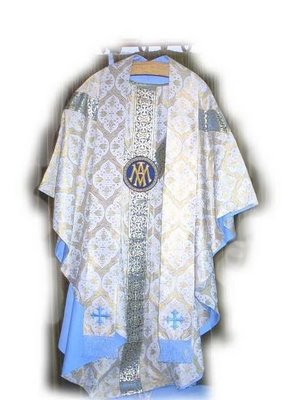
Vestments are those clothings worn for the liturgical rites. I'm often surprised by the inappropriate and cheap vestments that I've seen used in parishes. I'm not simply noting those vestments regularly seen which are worn, frayed, soiled, stained, wrinkled, etc. I'm talking about the quality of the vestment and it's appearance even when new. There are a variety of companies out there that provide liturgical supplies and for the large part their offerings in the category of vestments are ugly, of cheap quality while still managing to draw an exorbitant price, and often entirely inappropriate for use in liturgical rites.
As I live in the south western United States, I have an utter distaste for the fad which appeared here favoring a southwestern pattern and colors which have no Catholic or even Christian significance. I suppose when parishes and dioceses stop purchasing these horrid pseudo vestments these companies will stop making them. Now I understand the position of poor parishes having to make do with what they can, but when I see what they spend on the flower arrangements (perishable) and the cloths and banners to decorate the Church for the liturgical seasons (much of which is simply in poor taste) I'm not buying their excuses.

The chasuble above is a perfect example of how vestements ought to look. I realize that it's a semi-gothic style rather than the fiddleback and that's part of my point. There's a variety of styles to be found that are truly beautiful liturgical vestments. The chasuble above is from www.susanmaria.com. Please take the time to visit and browse the site. The vestments from this site are custom made. The price for this spectacular chasuble? An extremely reasonable $499.00 US. I've seen chasubles that are absolutely dreadful priced at above $1500.00.

Do you know a seminarian or priest? Then get together with other members of the parish, or if you have the means - do it yourself, and purchase a chasuble set with matching stole, chalice veil, and burse. Begin the return to beauty in our churches by donating these beautiful offerings yourself. This is after all how it is traditionally done. If anyone else knows of interesting sites that offer things like this then let us know.

Jun 2, 2006

Ordinations For The Diocese Of Phoenix

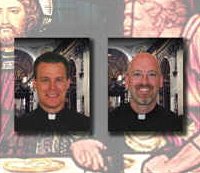
Please join me in prayer today for these two deacons, Rev. Mr. John Greb and Rev. Mr. John Lankeit (left to right), who are to be ordained to the priesthood tomorrow. Tonight at 7:oo p.m. the Most Reverend Bishop Thomas J. Olmstead, Diocese of Pheonix, and the seminarians of the diocese have invited the faithful to join them in a holy hour for these two men.

Tomorrow will be their ordination to the priesthood, which I will be attending. I look forward immensely to this joyous occasion. I will have the additional pleasure to be present at Fr. John Lankeit's Mass of Thanksgiving on Sunday at 11:00 a.m. Our diocese is blessed to be receiving these two men who have courageously answered God's call to the priesthood.

Please join those of us of the Diocese of Phoenix in offering prayers on behalf of these two men.

May 29, 2006

Theoretical Missal Project Via The New Liturgical Movement

In the beginning of May, Shawn Tribe of The New Liturgical Movement suggested to the readers of his blog that they attempt a theoretical revision of the Roman Rite.1 The idea intrigued me and so I set about doing just that. I've not given not submitted what I originally worked up, though I may do so yet. I've been following the discussions and I've found them illuminating if somewhat frustrating. One of the things that I admire about Shawn's blog is the wide readership and the vast cross section of comments that one finds there. I don't assume to speak for Shawn but I think that some of the commentors have entirely missed the point of the exercise. As I understood the "assignment" it was both a look at what sort of liturgy really is the outcome of the application of solid litugical principles and an exercise that allows one to reflect on the practical aspects of reforming the liturgy. To this end I believe that the idea was to look at a variety of opinions that could contribute to our understanding of the liturgical reform as it happened and to provide constructive criticism and discussion among his readership for whatever submissions are published. While some have criticized even the very attempt at producing theoretical missals for review, the process of so attempting has been fruitful and instructing for this reader.
I've always thought of myself as being solidly within the 'reform of the reform' camp. Ostensibly, this meant to me that I am neither for the continuation of current liturgical practice (as regards certain aspects of both the rubrics and the text) nor am I in favor of a wholesale return to the 1962 Roman Missal or its previous editions. I now see that while I have become quite adept at criticizing the reforms as they happened, my own efforts at creating a positive contribution in this regard fall apart under my very own criticisms of the current missal. I found it quite hard to restrain myself once I began the process of looking at just what a theoretical missal might look like. Allow me to outline in brief my thought process as I looked towards creating a theoretical missal.
The Prayers At The Foot Of The Altar
One of my criticisms of the Missa Normativa is that these prayers (Introibo, Judica me, Confiteor and versicles) are recognizable only in a form that is analagous to how a Pontiac Fiero resembles a Ferrari once it has been fitted with one of those ridiculous body kits. (My apologies to anyone reading this who drives one . . . and my condolences.) The separation of what is now called the Penitential Rite into options A, B and C are undesirable in my opinion and they are no longer said before ascending to the altar. The older prayers are developments to the Roman Rite around the 11th century and have their beginnings before this time in private and yet unscripted or unmandated customs. These prayers express the preparation of the priest and ministers before approaching the altar and all the rites of which I am aware have some form of a preparation even if their forms vary.
Taking my cue from the 1965 Roman Missal, I thought it no loss to drop the Judica Me entirely while leaving the Introibo antiphon and the Adjutorium nostrum. The Confiteor I thought to leave intact in form as found in the 1962 with the exception of the addition of "et omissione" as it is found in the Mozarabic, Carthusian, Dominican and other liturgies. However, I reduced the Confiteor to a single recitation by all but with the priest saying the Misereatur (nostri, nostris, nos) and Indulgentiam. I left intact the whole of the following versicles and responses. But the whole of this I moved to after the Introit or rather I should say that I moved the Introit to the actual procession after which these prayers are said before ascending to the altar.
It may be difficult to imagine the text above as I have layed it out, which is why I will probably submit it or make it available here. At this point I was quite happy with myself thinking that I had in large part maintained a close continuity with tradition and successfully incorporated these prayers in a more recognizable manner than the 1970 reform. Upon further reflection I think that the result was no less a concocted production than that of 1970. It is quite true that there are other venerable forms of the prayers at the foot of the altar which do not include the Introibo antiphon (Dominicans, Carthusian, Carmelite) but they have some other versicle and response in its place. Psalm 42 is recited in the Bragan and Mozarabic rite although it is not recited in the Gallican (Lyons) or Ambrosian even though they have the Introibo antiphon. In the end while I had tried to retain a traditional flavor through the selection of texts based upon the various traditional rites what I had drawn up was neither Roman nor did it conform to the useages of the other traditional rites. It was innovation pure and simple.
What was the necessity of these alterations of the Roman Rite? What liturgical principle had I been following? I think two things, at least, were at work in this theoretical revision. The first was a sincere desire to keep these laudable prayers in some form. It may help to know that these are the private prayers I use for my preparation when serving Mass (although I include the Judica me when I have sufficient time and always in Latin). So personal preference played a role even though I took a detailed look at various liturgies when considering what revisions I might make. This realization was for me quite shocking. My guiding principle: subjectivism (i.e. what I personally prefer). The second was I think simplification for the sake of simplification. I was approaching the missal with the intent to simplify its rites rather than seeking to simplify what only was necessary to simplify. For example, a good case can be made to drop the redundancy of the priest reciting the introit after the choir has sung it and such practices. What I had done here I cannot see as being innovations that are certainly and genuinely required for the good of the Church (SC, 23). In retrospect I think their are two ways to approach this either going the route of allowing the people to make the responses with the servers (already set forth by Pius XII in 1958) or in the interest of shorting the rites (SC, 34) maintaing their mandatory status but having them said in the sanctuary or merely omitting the Judica me. Though I think the former is more preferrable than the latter. In this way the text survives intact or almost so if the Judica me is omitted and remains a development of the Roman Rite rather than an entirely new ritual at the foot of the altar.
Other Alterations
Other alterations that I made were largely the same process of borrowing from another liturgy with slight tweaks. For example, I replaced the Suscipe sancte Pater and the Oferrimus tibi at the Offertory with the Ambrosian prayers as well as replacing the Roman Rite version of the Veni Sanctificator with the Sarum Rite version. In addition I did alter the Roman Canon but only by allowing the addition of the names of saints in the Communicantes and Nobis quoque, subject to the recognitio of the Holy See. In any case, the exercise was for me quite worthwhile and gave me a healthier respect for the kind of problems that are too easily encountered when attempting to make revisions to the liturgy.


May 15, 2006

A New Beginning

My apologies to all for my extended absence from this blog. I took a christmas vacation and then started the spring semester of college, began training as an acolyte (specifically for the Cathedral Church and pontifical masses) and shortly found myself wrapped up in so many other things that sitting down and writing just got put to the side.

In any case, I'll be taking up at least weekly posting if not more over the summer.

Christus surrexit!
Vere surrexit!

Dec 24, 2005

Ad Missam in die Nativitatis Domini

Missale Romanum ex decreto Sacrosancti Oecumenici Concilii Vaticani II instauratum, editio typica tertia: Ad Missam in die Nativitatis Domini

Introit: Is. 9:6, Ps. 97:1
Puer natus est nobis, et filius datus est nobis: cuius imperium super humerum eius: et vocabitur nomen eius, magni consilii Angelus. Ps. Cantate Domino canticum novum: qui mirabilia fecit.

A child is born to us, and a Son is given to us; Whose government is upon His shoulder; and His name chall be called the angel of great counsel. Ps. Sing ye to the Lord a new canticle; for He hath done wonderful things.

Collect
Deus, qui humanae substantiae dignitatemet mirabiliter condidisti, et mirabilius reformasti,da, quaesumus, nobis eius divinitatis esse consortes,qui humanitatis nostrae fieri dignatus est particeps.1

O God, who in a wondrous way created the dignity of human nature,and yet more wondrously shaped it anew, grant us, we beg, to be partakers of the Godhead of Him who deigned to become a participant of our humanity.2

Gradual: Ps. 97:3,2
Viderunt omnes fines terrae salutare Dei nostri: iubilate Deo omnis terra. V. Notum fecit Dominus salutare suum: ante conspectum gentium revelavit iustitiam suam.

All the ends of the earth have seen the salvation of our God: sing joyfully to God all the earth. V. The Lord hath made known His salvation; He hath revealed His justice in the sight of the Gentiles.

Alleluia
Alleluia. V. Dies sanctificas illuxit nobis: venite gentes, et adorate Dominum: quia hodie descendit lux magna super terram. Alleluia.

Alleluia. V. A hallowed day hath dawned for us: come, ye Gentiles, and adore the Lord; for this day a great light hath descended upon the earth. Alleluia.

Offertory Ps. 88:12,15
Tui sunt caeli, et tua est terra: orbem terrarum, et plenitudinem eius tu fundasti: iustitia et iudicium praeparatio sedis tuae.

Thine are the heavens, and Thine is the earth: the world and the fulness thereof Thou hast founded: justice and judgment are the preparation of Thy throne.

Super Oblata
Oblatio tibi sit, Domine, hodiernae sollemnitatis accepta,qua et nostrae reconciliationis processit perfecta placatio,et divini cultus nobis est indita plenitudo.3

O Lord, let the sacrificial offering of today’s solemnity be acceptable to You, from whence issued forth the completed appeasing of our reconciliation,and also was imparted to us the fullness of divine worship.4

Communio
Viderunt omnes fines terrae salutare Dei nostri.

All the ends of the earth have seen the salvation of our God.

Postcommunio
Praesta, misericors Deus, ut natus hodie Salvator mundi,sicut divinae nobis generationis est auctor,ita et immortalitatis sit ipse largitor.5

Grant, O merciful God, that just as the Savior of the world born today is for us the author of divine generation,so too may He be the bestower of immortality.6


* Translations taken from Father F.X. Lasance,The New Roman Missal, Christian Book Club of America, 1993, unless otherwise noted.

1 Missale Romanum ex decreto Sacrosancti Concilii Tridentini restitutum (num.Bruylants): Concede, quaesumus, omnipotens Deus: ut nos Unigeniti tui nova per carnem Nativitatis liberet: quos sub peccati jugo vetusta servitus tenet. (Grant, we beseech Thee, O almighty God, that the new birth, in the flesh, of Thine only-begotten Son may deliver us whom slavery from old doth keep under the yoke of sin.)

Cod. Bibl. Capit. Veron. LXXXV (80) Sacramentarium Veronese (Leonianum): [1239] Deus, qui in humanae substantiae dignitate et mirabiliter condedisti et mirabilius reformasti: da, quaesumus, nobis Iesu Christi filii tui ³: eius:³ diuinitatis esse consortes, qui humanitatis nostrae fieri dignatus est particeps MENSE DECEMBRI. XL. VIII KALENDAS IANUARIAS. NATALE DOMINI ET MARTYRUM PASTORIS BASILEI ET IOUIANI ET UICTORINI ET EUGENIAE ET FELICITATIS ET ANASTASIAE

Cod. Vat. Reg. lat. 316/Paris B.N. 7193, 41-56(Sacramentarium Gelasianum Vetus): [27] Deus, qui humanae substantiae dignitate et mirabiliter condedisti et mirabilius reformasti: da, quesumus, ut eius efficiamur in diuina consortes, qui nostrae humanitatis fieri dignatus est particeps, Christus filius tuus: per eundem dominum nostrum. ITEM ORATIONES DE NATALE DOMINI AD UESPEROS SIUE MATUTINOS LIBER I. V.

Liber Sacramentorum Engolismensis (Gel. VIII sec.): [33] Deus qui humanae substantiae dignitatem et mirabiliter condidisti et mirabilius reformasti, da quaesumus ut eius efficiamur in diuina consortes, qui nostrae humanitatis fieri dignatus est particeps Christus filius tuus. Per Tit: VI. ITEM ORATIONES DE NATALE DOMINI AD VESPEROS SIVE MATVTINAS

Cambrai, Bibl. Mun., ms.164 (159) Sacramentarium Hadrianum: [49] Concede quaesumus, omnipotens deus, ut nos unigeniti tui nova per carnem nativitas liberet, quos sub peccati iugo vetusta servitus tenet. Per eundem dominum nostrum iesum christum. Tit: IN NATALE DOMINI AD SANCTUM PETRUM GrP: 17.801; [59] Deus qui humanae substantiae dignitatem et mirabiliter condidisti, et mirabilius reformasti, da nobis quaesumus eius divinitatis esse consortes qui humanitatis nostrae fieri dignatus est participes. Per dominum. Tit: ALIAE ORATIONES DE NATALE DOMINI. Alia. GrP:

2 WDTPRS Translation by Father John Zuhlsdorf.

3 Missale Romanum ex decreto Sacrosancti Concilii Tridentini restitutum (num.Bruylants): [723] Oblata, Domine, munera nova Unigeniti tui Nativitate sanctifica: nosque a peccatorum nostrorum maculis emunda SO Die 25 Decembris. In Nativitate Domini. Ad tertiam missam in die(Sanctify our oblations, O Lord, by the new birth of Thy only-begotten Son, and cleanse us from the stains of our sins.)

Sacramentarium Veronese: [1249] Grata tibi sit, domine, quaesumus, hodiernae festiuitatis oblatio; ut tua gratia largiente per haec sacrosancta commercia in illius inueniamur forma, in quo tecum est nostra substantia MENSE DECEMBRI. XL. VIII KALENDAS IANUARIAS. NATALE DOMINI ET MARTYRUM PASTORIS BASILEI ET IOUIANI ET UICTORINI ET EUGENIAE ET FELICITATIS ET ANASTASIAE. IIII. ITEM ALIA; [1265] Oblatio tibi sit, domine, hodiernae festiuitatis accepta; qua et nostrae reconciliationis processit perfecta placatio, et diuini cultus nobis est indita plenitudo, et uia ueritatis et uita regni caelestis apparuit MENSE DECEMBRI. XL. VIII KALENDAS IANUARIAS. NATALE DOMINI ET MARTYRUM PASTORIS BASILEI ET IOUIANI ET UICTORINI ET EUGENIAE ET FELICITATIS ET ANASTASIAE. VIII. ITEM ALIA.

Sacramentarium Gelasianum: [19] Oblatio tibi sit, domine, hodierna festiuitatis accepta, quia et nostrae reconciliationis processit perfecta placatio, et diuini cultus nobis est indita plenitudo Iesu Christi domini nostri: qui tecum uiuit. ITEM IN NATALE DOMINI IN DIE secreta LIBER I. IIII.

Sacramentorum Englosismensis: [3] Accepta tibi sit Domine quaesumus hodiernae festiuitatis oblatio, ut tua gratia largiente per haec sacrosancta commercia in illius inueniamur forma, in quo te cum est nostra substantia. Per Dominum nostrum Tit: None; [23] Oblatio tibi sit Domine hodiernae festiuitatis accepta, qua et nostrae reconciliationis processit perfecta placatio, et diuini cultus nobis est indita plenitudo Iesu Christi Domini nostri qui tecum Tit: V. IN NATALE DOMINI AD SANCTVM PETRVM IN DIE SECRETA.

Sacramentarium Hadrianum: [37] Accepta tibi sit, domine, quaesumus, hodiernae festivitatis oblatio, ut tua gratia largiente per haec sacrosancta commertia in illius inveniamur forma, in quo est nostra substantia. Per dominum. Tit: VIII KALENDAS IANUARIAS ID EST XXV DIE MENSIS DECEMBRIS NATALE DOMINI AD SANCTAM MARIAM MAIOREM. Super oblata. GrP: 5

4 WDTPRS Translation by Father John Zuhlsdorf.


5 Missale Romanum ex decreto Sacrosancti Concilii Tridentini restitutum (num.Bruylants): [858] Praesta, quaesumus, omnipotens Deus: ut natus hodie Salvator mundi, sicut divinae nobis generationis est auctor; ita et immortalitatis sit ipse largitor PC Die 25 Dec. In Nativitate Domini. Ad tertiam missam in die.

Sacramentarium Hadrianum: [53] Praesta quaesumus, omnipotens deus, ut natus hodie salvator mundi, sicut divinae nobis generationis est auctor, ita et inmortalitatis sit ipse largitor. (bis) Concede quaesumus omnipotens deus ut quos sub peccati iugo vestusta servitus tenet, eos unigeniti tui nova per carnem nativitas liberet. Qui tecum.Tit: IN NATALE DOMINI AD SANCTUM PETRUM. Ad completa / bis = ALIAE ORATIONES DE NATALE DOMINI GrP: 19; [56] Deus qui per beatae virginis partum sine humana concupiscentia procreatum, in filii tui membra venientis paternis fecisti praeiudiciis non teneri, praesta quaesumus, ut huius creaturae novitate suscepti, vetustatis antiquae contagiis exuamur. Per. Tit: ALIAE ORATIONES DE NATALE DOMINI. Alia oratio. GrP: 22

Sacramentorum Englosismensis: [29] Praesta quaesumus misericors Deus, ut natus hodie saluator mundi, sicut diuinae nobis generationis est auctor, ita et inmortalitatis sit ipse largitor. Per Tit: V. IN NATALE DOMINI AD SANCTVM PETRVM IN DIE
Sacramentarium Gelasianum: [18] Praesta, misericors deus, ut natus hodie saluatar, sicut diuinae generationis est auctor, ita et inmortalitatis sit ipse largitor: per. ITEM IN NATALE DOMINI IN DIE LIBER I. IIII.

Sacramentarium Veronese (Leonianum): [1271] Presta, misericors deus, ut natus hodie saluator mundi, sicut diuinae nobis generationis est auctor, ita et inmortalitatis sit ipse largitor MENSE DECEMBRI. XL. VIII KALENDAS IANUARIAS. NATALE DOMINI ET MARTYRUM PASTORIS BASILEI ET IOUIANI ET UICTORINI ET EUGENIAE ET FELICITATIS ET ANASTASIAE. VIIII. ITEM ALIA

6 WDTPRS Translation by Father John Zuhlsdorf.

Sermons For Christmas - II

The Nativity of our Lord

The Threefold Office of Jesus Christ.
S. John i. 4. - "The life was the light of men."


In this Gospel the Child Who is born is called the Word - "In the beginning was the Word"; the "Light" and the "life" - "The Life was the Light of men." From this is learned the threefold benefit which His Incarnation conferred upon man.

Jesus Christ Incarnate was:

I. Firstly, the Word, teaching man - "Jesus went about all Galilee teaching" (S. Matt. iv. 23); and He taught us three things:

1. Physics, which inquires into the nature of things; for Jesus Christ taught us the quality of things when He taught the deceit of the world, the treachery of the devil, and the truth of God.

2. Logic, which proves what is true, teaching the truth of Holy Scripture - "Then opened He their understanding, that they might understand the Scriptures" (S. Luke xxiv. 45).

3. Ethics, which is probity of manners, when He taught holiness of life - "Blessed are the meek, the merciful, the pure in heart" (S. Matt. v. 3-12); "Ye call Me Master [Teacher] and Lord, and ye say well: for so I am" (S. John xiii. 13).

II. Secondly, the Light, enlightening men. Our Blessed Lord enlightens in three ways:

1. By expelling the night of sin.

2. By bringing in the day of grace - "The night is far spent, the day is at hand" (Rom. xiii. 12).

3. By diffusing great lights, which are the Saints, throughout the world - "Among whom ye shine as lights in the world" (Philipp. ii. 15).

III. Thirdly, the Life, leading on to eternity:

1. Repairing our life by His Resurrection - "I am the Resurrection and the Life" (S. John xi. 25).

2. Endowing this life with grace - "Because I live, ye shall live also" (S. John xiv. 19).

3. Granting a life of glory - "I will give unto them eternal life" (S. John x. 28).


S. Thoma de Aquino


Ashley, John M. B.C.L., The Homilies of St. Thomas Aquinas, Roman Catholic Books, First published in 1873.

Sermons For Christmas - I

Gospel: Luke 2:1-14 Year A

In those days Caesar Augustus published a decree ordering a census of the whole world. And so Joseph went from the town of Nazareth to Galilee.

Commentary: Sermon 193, 1-2

When the gospel was read, we heard the voices of angels announcing to the shepherds that the Lord Jesus Christ was born of the virgin: Glory to God in the highest, and on earth peace to people of good will. Festive voices, congratulating not just one woman whose womb had been delivered of offspring, but the whole human race, for whom the virgin had borne the savior. It was right, you see, and altogether fitting, that the one who carried in her womb the Lord of heaven and earth, and after giving birth to him remained virginally intact, should be hailed in her childbearing, not by a pack of women with solemn human rites, but by angels with glorious divine praises. Let us too then say, and say with all the jubilation we can muster - because we aren't announcing his birth to shepherds watching their flocks, but celebrating his birthday with his sheep; let us too say, I repeat, with faithful hearts and loyal voices, Glory to God in the highest, and on earth peace to people of good will.

Let us take as close and shrewd a look as we can at these divine words, these praises of God, this exultant joy of the angels, and meditate on it in faith and hope and charity. For in accordance with what we believe and hope and desire, we too will be glory to God in the highest, when with the spiritual body rising again we are snatched up to meet Christ in the clouds, providing that meanwhile, as long as we are on earth, we pursue peace with good will. But all who would have life and love to see good days, let them curb their tongues from evil and their lips from speaking deceit; let them turn aside from evil and do good, and in this way be people of good will. And let them seek peace and pursue it, because on earth peace to people of good will.

But if you say, man, "Look, to will is available to me, but to perform the good I do not find in myself," and if you delight in the law of God according to the inner self, but see another law in your members fighting back against the law of your mind, and taking you prisoner to the law of sin which is in your members, persist in your good will, and cry out what follows: Wretched man that I am, who will set me free from the body of this death? The grace of God, through Jesus Christ our Lord.

He, you see, after the war in which the flesh lusts against the spirit, and the spirit against the flesh, so that it is not the things you wish that you do, is peace on earth to people of good will, because he is our peace, who has made the two into one. So let good will persist in standing firm against evil desires, and persist in imploring the help of God's grace, through Jesus Christ our Lord. The law in the members of the flesh is fighting back against it, and here it is, already being taken prisoner. Let it implore help and not trust in its own powers; and even if weary and in distress, let it at least not be too proud to confess. One will be at hand, don't forget, who said to people that already, as he could see, believed in him, If you remain in my word, you will truly be my disciples, and you will recognize the truth, and the truth will set you free. Truth will be at hand to set you free from the body of his death. That, for sure, is why Truth, whose birthday we are celebrating, has sprung from the earth, in order to be peace on earth to people of good will.
S. Aurelius Augustinus

Rotelle, John E., Augustine on the Sunday Gospel, Augustinian Press, 1998, pp. 33-34.