Jun 16, 2006

Organic Development, Innovation And Fabrication

Back in December of 2005, I posted some questions concerning the principles for organic development of the liturgy over at LEI. Recently Shawn Tribe of NLM reported to his readers about the Research Institute for Catholic Liturgy (RICL) conference which featured Dr. Alcuin Reid, well-known priest, author and scholar (The Organic Development of the Liturgy). Shawn's synthesis of Dr. Reid's talks led me to consider again this subject which from time to time resurfaces, especially when I'm studying the actual texts of ancient liturgies. Recently, I also blogged about NLM's Theoretical Missal Project and my own experience with it gave me greater insight into the process of the development of the liturgy.

I don't claim to be able to formulate a strict definition of what constitutes organic development, though I'm closer to understanding the principles of organic development through the process of negation. As one reader of Shawn's article on the RICL Conference notes: it's the bulk of the changes to the Ordo Missae of the Roman Rite that tend to advertise that there just may be a break with organic development going on. The Theoretical Missal Project made me realize something else though. As I've continued my studies of the liturgy and especially as I've broken down the prayers of the Ordo Missae (both classical and modern), I've come to the realization that it's not just the aggregate but also the individual parts that contribute to that aggregate which are examples of inorganic development. Mathematically it is self evident that if the aggregate shows signs of a break with tradition then it must be because the parts, or at least some parts, are breaks with tradition. I think that sometimes this is obscured when we isolate the prayers of the liturgy into it's rituals, and those rituals into their components, for analysis.

For example, in my own treatment of the revision of the Confiteor, I made references to that of other liturgical uses to defend the orthodoxy of the result. I continue to affirm the orthodoxy of the Confiteor in the modern rite, but that somewhat misses the point doesn't it? The Second Vatican Council explicitly says that no innovations should be made unless the good of the Church certainly required it and also cautions that these innovations should develop from the forms already present. The addition of et ommissione can certainly be understood on a theological basis as an alteration for the good of the Church, though it might be argued that it is at least not obvious that it was certainly required as such. The break in the form of the Confiteor to mirror the Dominican and Carthusian version does also draw from the liturgical richness of forms which already exist, while still maintaining certain aspects of the former tradition such as the triple mea culpa. Yet, when one puts the result (i.e. aggregate) next to the former version does it not at least appear inorganic? To get a picture of what I'm talking about let's compare the versions with only a single alteration at a time.


Confíteor Deo omnipoténti, beátæ Maríæ semper Vírgini, beáto Michaéli Archángelo, beáto Joanni Baptístæ, sanctis Apóstolis Petro et Paulo, ómnibus Sanctis, et vobis, fratres (et tibi, Pater): quia peccávi nimis cogitatióne, verbo et ópere: mea culpa, mea culpa, mea máxima culpa. Ideo precor beátam Maríam semper Vírginem, beátum Michaélem Archángelum, beátum Joánnem Baptístam, sanctos Apóstolos Petrum et Paulum, omnes Sanctos, et vos, fratres (et te, Pater), oráre pro me ad Dóminum Deum nostrum.

Confíteor Deo omnipoténti, beátæ Maríæ semper Vírgini, beáto Michaéli Archángelo, beáto Joanni Baptístæ, sanctis Apóstolis Petro et Paulo, ómnibus Sanctis, et vobis, fratres( et tibi, Pater): quia peccávi nimis cogitatióne, verbo, ópere et omissione: mea culpa, mea culpa, mea máxima culpa. Ideo precor beátam Maríam semper Vírginem, beátum Michaélem Archángelum, beátum Joánnem Baptístam, sanctos Apóstolos Petrum et Paulum, omnes Sanctos, et vos, fratres (et te, Pater), oráre pro me ad Dóminum Deum nostrum.

Confíteor Deo omnipoténti, beátæ Maríæ semper Vírgini, beáto Michaéli Archángelo, beáto Joanni Baptístæ, sanctis Apóstolis Petro et Paulo, ómnibus Sanctis, et vobis, fratres: quia peccávi nimis cogitatióne, verbo et ópere: mea culpa, mea culpa, mea máxima culpa. Ideo precor beátam Maríam semper Vírginem, beátum Michaélem Archángelum, beátum Joánnem Baptístam, sanctos Apóstolos Petrum et Paulum, omnes Sanctos, et vobis, fratres, oráre pro me ad Dóminum Deum nostrum.

Confíteor Deo omnipoténti, (*) et vobis, fratres (et tibi, Pater): quia peccávi nimis cogitatióne, verbo et ópere: mea culpa, mea culpa, mea máxima culpa. Ideo precor beátam Maríam semper Vírginem, (*) omnes Angelos et Sanctos, et vos, fratres (et te, Pater), oráre pro me ad Dóminum Deum nostrum.

Confíteor Deo omnipoténti, (*) et vobis, fratres: quia peccávi nimis cogitatióne, verbo ópere et ommissione: mea culpa, mea culpa, mea máxima culpa. Ideo precor beátam Maríam semper Vírginem, (*) omnes Angelos et Sanctos, et vos, fratres, oráre pro me ad Dóminum Deum nostrum.


As we look at each alteration to the Confiteor as it had been used in the Roman Missal since at least the High Middle Ages the most striking innovation is the suppression of the list of saints (St. Michael, St. John the Baptist, and Sts. Peter and Paul). The second is the suppression of the alternating recitations by the Priest and then the server which results in a single recitation by all. The additions of omissione and Angelos seem relatively insignificant. The result is a product which does not seem to organically grow out of already existing forms. When we add to this the alteration of the rubrics (it is no longer said at the foot of the altar or bowing, the striking of the breast is reduced from three to one, and the recitation of the Confiteor has become one of four Penitential Rite options, if we include the Aspersion Rite) the inorganic nature of the resultant product is even more glaring. Such an exercise also helps us to identify the portions of inorganic alterations as being primarily that of the suppression of the named saints, the reduction to a single recitation, and the alteration of the rubrics. More importantly this example is one that is of a minor ritual considered among the more important and extensive alterations to the missal.

Thus, we can begin to see what is meant by the accusation that the reformed liturgy is a banal on-the-spot fabrication using materials from which the classical liturgy had been formed. The restructuring of these materials by a committee of so-called experts and the resulting product is exactly what gives the impression that the liturgy is what we make of it rather than something that is handed on from tradition. One reader of NLM made the very astute point:

"Few of the changes on their own cannot be defended [as to their orthodoxy]. Few of the prayers we have are without merit, as anyone who has followed Fr. Zuhlsdorf's translations of the proper prayers of the day can easily see. Most of them, indeed, are derived from ancient Western sacramentaries.Even the prayers for the Preparation of the Gifts have their excellencies--Pope Benedict used them beautifully for his homily today on Corpus Christi. And he CHOSE to use the Second Eucharistic Prayer--and on a great Feast Day, too. How it will be improved by phrases such as, "the dew of your Spirit"! I believe Ratzinger hopes that the Novus Ordo will become organic over time, in a backwards fashion, if you like, through infusion of older forms and a return of the 'spirit' of the Roman liturgy operating on materials that are not entirely unworthy, by any means. I think where Ratzinger parts from many traditionalists is that he accepts that the changes in fact have been made and that we must FIRST learn to receive them anew and infuse them with a liturgical spirit before any substantial changes can be made. THOSE changes--whatever they may be--will have to be made over a long time under the guidance of the Holy Spirit. A parallel return to and reacquaintance with the older forms will help THAT process to be an organic one and return to the liturgy those essential elements--whether in old or new forms--that may have been lost. There is no HELP for the fact that a process that seemed--and in some ways WAS--artificial was used in the past. The result is now the normative liturgy of the Church. The processes outlined above (and proposed in God and the World and other places) are what we must rely on to "de-artificialize" the forms of our worship. An illustration of Ratzinger's perhaps paradoxical seeming attitude can be gleaned from yesterday's Corpus Christi Mass. The Pope deliberately chose--as he has at least once before (in Bari last year)--to use the Second Eucharistic Prayer. And in his homily, he drew from the words of the Prayers in Preparation of the Gifts (the ones that replace the Offertory Prayers, beginning with "Blessed are you, Lord God of all Creation, through your goodness we have this bread to offer..."). He sets us an example of the Pope being UNDER the liturgy and RECEIVING it along with the rest of us. This spirit, which he recommends to all of us, will in the end do more for liturgical tradition than many an obstreperous attitude." [brackets mine for clarification]Jeff

I think Jeff has got it exactly right. Whatever the criticisms of the reformed liturgy, we too must be careful not to add to the errors of the reformers by solidifying the application of faulty principles of reform. Even if the goal is laudable we cannot allow the process of "reverse engineering" those faulty reforms to add to the destruction of the spirit of the liturgy and the conception of the liturgy as a technical production of experts. If we succumb to these same principles that led the Concilium and earlier reformers astray we will fall prey to the same faults that they did. For if we achieved the reestablishing of the traditional liturgy in all the Roman parishes around the world, it would be viewed by those displeased at such a triumph as nothing other than the liturgical opinions and desires of experts that happened this time to be ultra conservative or traditionalists. And so they would simply set about, once again, planning the destruction of our liturgical heritage. Let us note the example of Benedict XVI and likewise set about recovering what is lost to the liturgy according to right principles.

Jun 15, 2006

New English Translation For The Order Of The Mass

"On the vote for the translation of the Missale Romanum, the ayes were 173, the nays 29.

On the adaptations to the Missale Romanum for the United States, the ayes were 184, the nays 8.

Needing 168 votes to pass, the translation has passed" Whispers in the Loggia by Rocco Palma. (See also the Associated Press release here. )

This is extremely good news. The next step is recognitio. It's up in the air on whether the new translation, once it receives recognitio from Rome, would be put into use immediately or await the approval and recognitio for the new translation of the rest of the Roman Missal. The approval today was garnered for the Ordinary of the Mass alone. The process of recognitio could take some time, but then this also depends on whether the translation as such is in accord with Vatican guidlines such as Liturgiam Authenticam. Even if recognitio from Rome comes rather quickly the Bishops may not put it into place until the entire Roman Missal is approved, in which case we could still be several years away from an accurate and faithful translation. We'll also have to wait and see what it is that actually was approved, since there were some 60 changes approved as well.

Laudetur Iesus Christus!

Jun 9, 2006

Vestes Sacrae

Vestments are those clothings worn for the liturgical rites. I'm often surprised by the inappropriate and cheap vestments that I've seen used in parishes. I'm not simply noting those vestments regularly seen which are worn, frayed, soiled, stained, wrinkled, etc. I'm talking about the quality of the vestment and it's appearance even when new. There are a variety of companies out there that provide liturgical supplies and for the large part their offerings in the category of vestments are ugly, of cheap quality while still managing to draw an exorbitant price, and often entirely inappropriate for use in liturgical rites.
As I live in the south western United States, I have an utter distaste for the fad which appeared here favoring a southwestern pattern and colors which have no Catholic or even Christian significance. I suppose when parishes and dioceses stop purchasing these horrid pseudo vestments these companies will stop making them. Now I understand the position of poor parishes having to make do with what they can, but when I see what they spend on the flower arrangements (perishable) and the cloths and banners to decorate the Church for the liturgical seasons (much of which is simply in poor taste) I'm not buying their excuses.

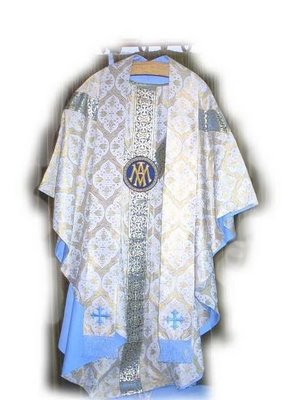
The chasuble above is a perfect example of how vestements ought to look. I realize that it's a semi-gothic style rather than the fiddleback and that's part of my point. There's a variety of styles to be found that are truly beautiful liturgical vestments. The chasuble above is from www.susanmaria.com. Please take the time to visit and browse the site. The vestments from this site are custom made. The price for this spectacular chasuble? An extremely reasonable $499.00 US. I've seen chasubles that are absolutely dreadful priced at above $1500.00.

Do you know a seminarian or priest? Then get together with other members of the parish, or if you have the means - do it yourself, and purchase a chasuble set with matching stole, chalice veil, and burse. Begin the return to beauty in our churches by donating these beautiful offerings yourself. This is after all how it is traditionally done. If anyone else knows of interesting sites that offer things like this then let us know.

Jun 2, 2006

Ordinations For The Diocese Of Phoenix

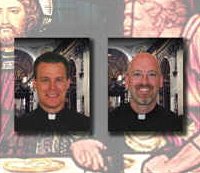
Please join me in prayer today for these two deacons, Rev. Mr. John Greb and Rev. Mr. John Lankeit (left to right), who are to be ordained to the priesthood tomorrow. Tonight at 7:oo p.m. the Most Reverend Bishop Thomas J. Olmstead, Diocese of Pheonix, and the seminarians of the diocese have invited the faithful to join them in a holy hour for these two men.

Tomorrow will be their ordination to the priesthood, which I will be attending. I look forward immensely to this joyous occasion. I will have the additional pleasure to be present at Fr. John Lankeit's Mass of Thanksgiving on Sunday at 11:00 a.m. Our diocese is blessed to be receiving these two men who have courageously answered God's call to the priesthood.

Please join those of us of the Diocese of Phoenix in offering prayers on behalf of these two men.

May 29, 2006

Theoretical Missal Project Via The New Liturgical Movement

In the beginning of May, Shawn Tribe of The New Liturgical Movement suggested to the readers of his blog that they attempt a theoretical revision of the Roman Rite.1 The idea intrigued me and so I set about doing just that. I've not given not submitted what I originally worked up, though I may do so yet. I've been following the discussions and I've found them illuminating if somewhat frustrating. One of the things that I admire about Shawn's blog is the wide readership and the vast cross section of comments that one finds there. I don't assume to speak for Shawn but I think that some of the commentors have entirely missed the point of the exercise. As I understood the "assignment" it was both a look at what sort of liturgy really is the outcome of the application of solid litugical principles and an exercise that allows one to reflect on the practical aspects of reforming the liturgy. To this end I believe that the idea was to look at a variety of opinions that could contribute to our understanding of the liturgical reform as it happened and to provide constructive criticism and discussion among his readership for whatever submissions are published. While some have criticized even the very attempt at producing theoretical missals for review, the process of so attempting has been fruitful and instructing for this reader.
I've always thought of myself as being solidly within the 'reform of the reform' camp. Ostensibly, this meant to me that I am neither for the continuation of current liturgical practice (as regards certain aspects of both the rubrics and the text) nor am I in favor of a wholesale return to the 1962 Roman Missal or its previous editions. I now see that while I have become quite adept at criticizing the reforms as they happened, my own efforts at creating a positive contribution in this regard fall apart under my very own criticisms of the current missal. I found it quite hard to restrain myself once I began the process of looking at just what a theoretical missal might look like. Allow me to outline in brief my thought process as I looked towards creating a theoretical missal.
The Prayers At The Foot Of The Altar
One of my criticisms of the Missa Normativa is that these prayers (Introibo, Judica me, Confiteor and versicles) are recognizable only in a form that is analagous to how a Pontiac Fiero resembles a Ferrari once it has been fitted with one of those ridiculous body kits. (My apologies to anyone reading this who drives one . . . and my condolences.) The separation of what is now called the Penitential Rite into options A, B and C are undesirable in my opinion and they are no longer said before ascending to the altar. The older prayers are developments to the Roman Rite around the 11th century and have their beginnings before this time in private and yet unscripted or unmandated customs. These prayers express the preparation of the priest and ministers before approaching the altar and all the rites of which I am aware have some form of a preparation even if their forms vary.
Taking my cue from the 1965 Roman Missal, I thought it no loss to drop the Judica Me entirely while leaving the Introibo antiphon and the Adjutorium nostrum. The Confiteor I thought to leave intact in form as found in the 1962 with the exception of the addition of "et omissione" as it is found in the Mozarabic, Carthusian, Dominican and other liturgies. However, I reduced the Confiteor to a single recitation by all but with the priest saying the Misereatur (nostri, nostris, nos) and Indulgentiam. I left intact the whole of the following versicles and responses. But the whole of this I moved to after the Introit or rather I should say that I moved the Introit to the actual procession after which these prayers are said before ascending to the altar.
It may be difficult to imagine the text above as I have layed it out, which is why I will probably submit it or make it available here. At this point I was quite happy with myself thinking that I had in large part maintained a close continuity with tradition and successfully incorporated these prayers in a more recognizable manner than the 1970 reform. Upon further reflection I think that the result was no less a concocted production than that of 1970. It is quite true that there are other venerable forms of the prayers at the foot of the altar which do not include the Introibo antiphon (Dominicans, Carthusian, Carmelite) but they have some other versicle and response in its place. Psalm 42 is recited in the Bragan and Mozarabic rite although it is not recited in the Gallican (Lyons) or Ambrosian even though they have the Introibo antiphon. In the end while I had tried to retain a traditional flavor through the selection of texts based upon the various traditional rites what I had drawn up was neither Roman nor did it conform to the useages of the other traditional rites. It was innovation pure and simple.
What was the necessity of these alterations of the Roman Rite? What liturgical principle had I been following? I think two things, at least, were at work in this theoretical revision. The first was a sincere desire to keep these laudable prayers in some form. It may help to know that these are the private prayers I use for my preparation when serving Mass (although I include the Judica me when I have sufficient time and always in Latin). So personal preference played a role even though I took a detailed look at various liturgies when considering what revisions I might make. This realization was for me quite shocking. My guiding principle: subjectivism (i.e. what I personally prefer). The second was I think simplification for the sake of simplification. I was approaching the missal with the intent to simplify its rites rather than seeking to simplify what only was necessary to simplify. For example, a good case can be made to drop the redundancy of the priest reciting the introit after the choir has sung it and such practices. What I had done here I cannot see as being innovations that are certainly and genuinely required for the good of the Church (SC, 23). In retrospect I think their are two ways to approach this either going the route of allowing the people to make the responses with the servers (already set forth by Pius XII in 1958) or in the interest of shorting the rites (SC, 34) maintaing their mandatory status but having them said in the sanctuary or merely omitting the Judica me. Though I think the former is more preferrable than the latter. In this way the text survives intact or almost so if the Judica me is omitted and remains a development of the Roman Rite rather than an entirely new ritual at the foot of the altar.
Other Alterations
Other alterations that I made were largely the same process of borrowing from another liturgy with slight tweaks. For example, I replaced the Suscipe sancte Pater and the Oferrimus tibi at the Offertory with the Ambrosian prayers as well as replacing the Roman Rite version of the Veni Sanctificator with the Sarum Rite version. In addition I did alter the Roman Canon but only by allowing the addition of the names of saints in the Communicantes and Nobis quoque, subject to the recognitio of the Holy See. In any case, the exercise was for me quite worthwhile and gave me a healthier respect for the kind of problems that are too easily encountered when attempting to make revisions to the liturgy.


May 15, 2006

A New Beginning

My apologies to all for my extended absence from this blog. I took a christmas vacation and then started the spring semester of college, began training as an acolyte (specifically for the Cathedral Church and pontifical masses) and shortly found myself wrapped up in so many other things that sitting down and writing just got put to the side.

In any case, I'll be taking up at least weekly posting if not more over the summer.

Christus surrexit!
Vere surrexit!

Dec 24, 2005

Ad Missam in die Nativitatis Domini

Missale Romanum ex decreto Sacrosancti Oecumenici Concilii Vaticani II instauratum, editio typica tertia: Ad Missam in die Nativitatis Domini

Introit: Is. 9:6, Ps. 97:1
Puer natus est nobis, et filius datus est nobis: cuius imperium super humerum eius: et vocabitur nomen eius, magni consilii Angelus. Ps. Cantate Domino canticum novum: qui mirabilia fecit.

A child is born to us, and a Son is given to us; Whose government is upon His shoulder; and His name chall be called the angel of great counsel. Ps. Sing ye to the Lord a new canticle; for He hath done wonderful things.

Collect
Deus, qui humanae substantiae dignitatemet mirabiliter condidisti, et mirabilius reformasti,da, quaesumus, nobis eius divinitatis esse consortes,qui humanitatis nostrae fieri dignatus est particeps.1

O God, who in a wondrous way created the dignity of human nature,and yet more wondrously shaped it anew, grant us, we beg, to be partakers of the Godhead of Him who deigned to become a participant of our humanity.2

Gradual: Ps. 97:3,2
Viderunt omnes fines terrae salutare Dei nostri: iubilate Deo omnis terra. V. Notum fecit Dominus salutare suum: ante conspectum gentium revelavit iustitiam suam.

All the ends of the earth have seen the salvation of our God: sing joyfully to God all the earth. V. The Lord hath made known His salvation; He hath revealed His justice in the sight of the Gentiles.

Alleluia
Alleluia. V. Dies sanctificas illuxit nobis: venite gentes, et adorate Dominum: quia hodie descendit lux magna super terram. Alleluia.

Alleluia. V. A hallowed day hath dawned for us: come, ye Gentiles, and adore the Lord; for this day a great light hath descended upon the earth. Alleluia.

Offertory Ps. 88:12,15
Tui sunt caeli, et tua est terra: orbem terrarum, et plenitudinem eius tu fundasti: iustitia et iudicium praeparatio sedis tuae.

Thine are the heavens, and Thine is the earth: the world and the fulness thereof Thou hast founded: justice and judgment are the preparation of Thy throne.

Super Oblata
Oblatio tibi sit, Domine, hodiernae sollemnitatis accepta,qua et nostrae reconciliationis processit perfecta placatio,et divini cultus nobis est indita plenitudo.3

O Lord, let the sacrificial offering of today’s solemnity be acceptable to You, from whence issued forth the completed appeasing of our reconciliation,and also was imparted to us the fullness of divine worship.4

Communio
Viderunt omnes fines terrae salutare Dei nostri.

All the ends of the earth have seen the salvation of our God.

Postcommunio
Praesta, misericors Deus, ut natus hodie Salvator mundi,sicut divinae nobis generationis est auctor,ita et immortalitatis sit ipse largitor.5

Grant, O merciful God, that just as the Savior of the world born today is for us the author of divine generation,so too may He be the bestower of immortality.6


* Translations taken from Father F.X. Lasance,The New Roman Missal, Christian Book Club of America, 1993, unless otherwise noted.

1 Missale Romanum ex decreto Sacrosancti Concilii Tridentini restitutum (num.Bruylants): Concede, quaesumus, omnipotens Deus: ut nos Unigeniti tui nova per carnem Nativitatis liberet: quos sub peccati jugo vetusta servitus tenet. (Grant, we beseech Thee, O almighty God, that the new birth, in the flesh, of Thine only-begotten Son may deliver us whom slavery from old doth keep under the yoke of sin.)

Cod. Bibl. Capit. Veron. LXXXV (80) Sacramentarium Veronese (Leonianum): [1239] Deus, qui in humanae substantiae dignitate et mirabiliter condedisti et mirabilius reformasti: da, quaesumus, nobis Iesu Christi filii tui ³: eius:³ diuinitatis esse consortes, qui humanitatis nostrae fieri dignatus est particeps MENSE DECEMBRI. XL. VIII KALENDAS IANUARIAS. NATALE DOMINI ET MARTYRUM PASTORIS BASILEI ET IOUIANI ET UICTORINI ET EUGENIAE ET FELICITATIS ET ANASTASIAE

Cod. Vat. Reg. lat. 316/Paris B.N. 7193, 41-56(Sacramentarium Gelasianum Vetus): [27] Deus, qui humanae substantiae dignitate et mirabiliter condedisti et mirabilius reformasti: da, quesumus, ut eius efficiamur in diuina consortes, qui nostrae humanitatis fieri dignatus est particeps, Christus filius tuus: per eundem dominum nostrum. ITEM ORATIONES DE NATALE DOMINI AD UESPEROS SIUE MATUTINOS LIBER I. V.

Liber Sacramentorum Engolismensis (Gel. VIII sec.): [33] Deus qui humanae substantiae dignitatem et mirabiliter condidisti et mirabilius reformasti, da quaesumus ut eius efficiamur in diuina consortes, qui nostrae humanitatis fieri dignatus est particeps Christus filius tuus. Per Tit: VI. ITEM ORATIONES DE NATALE DOMINI AD VESPEROS SIVE MATVTINAS

Cambrai, Bibl. Mun., ms.164 (159) Sacramentarium Hadrianum: [49] Concede quaesumus, omnipotens deus, ut nos unigeniti tui nova per carnem nativitas liberet, quos sub peccati iugo vetusta servitus tenet. Per eundem dominum nostrum iesum christum. Tit: IN NATALE DOMINI AD SANCTUM PETRUM GrP: 17.801; [59] Deus qui humanae substantiae dignitatem et mirabiliter condidisti, et mirabilius reformasti, da nobis quaesumus eius divinitatis esse consortes qui humanitatis nostrae fieri dignatus est participes. Per dominum. Tit: ALIAE ORATIONES DE NATALE DOMINI. Alia. GrP:

2 WDTPRS Translation by Father John Zuhlsdorf.

3 Missale Romanum ex decreto Sacrosancti Concilii Tridentini restitutum (num.Bruylants): [723] Oblata, Domine, munera nova Unigeniti tui Nativitate sanctifica: nosque a peccatorum nostrorum maculis emunda SO Die 25 Decembris. In Nativitate Domini. Ad tertiam missam in die(Sanctify our oblations, O Lord, by the new birth of Thy only-begotten Son, and cleanse us from the stains of our sins.)

Sacramentarium Veronese: [1249] Grata tibi sit, domine, quaesumus, hodiernae festiuitatis oblatio; ut tua gratia largiente per haec sacrosancta commercia in illius inueniamur forma, in quo tecum est nostra substantia MENSE DECEMBRI. XL. VIII KALENDAS IANUARIAS. NATALE DOMINI ET MARTYRUM PASTORIS BASILEI ET IOUIANI ET UICTORINI ET EUGENIAE ET FELICITATIS ET ANASTASIAE. IIII. ITEM ALIA; [1265] Oblatio tibi sit, domine, hodiernae festiuitatis accepta; qua et nostrae reconciliationis processit perfecta placatio, et diuini cultus nobis est indita plenitudo, et uia ueritatis et uita regni caelestis apparuit MENSE DECEMBRI. XL. VIII KALENDAS IANUARIAS. NATALE DOMINI ET MARTYRUM PASTORIS BASILEI ET IOUIANI ET UICTORINI ET EUGENIAE ET FELICITATIS ET ANASTASIAE. VIII. ITEM ALIA.

Sacramentarium Gelasianum: [19] Oblatio tibi sit, domine, hodierna festiuitatis accepta, quia et nostrae reconciliationis processit perfecta placatio, et diuini cultus nobis est indita plenitudo Iesu Christi domini nostri: qui tecum uiuit. ITEM IN NATALE DOMINI IN DIE secreta LIBER I. IIII.

Sacramentorum Englosismensis: [3] Accepta tibi sit Domine quaesumus hodiernae festiuitatis oblatio, ut tua gratia largiente per haec sacrosancta commercia in illius inueniamur forma, in quo te cum est nostra substantia. Per Dominum nostrum Tit: None; [23] Oblatio tibi sit Domine hodiernae festiuitatis accepta, qua et nostrae reconciliationis processit perfecta placatio, et diuini cultus nobis est indita plenitudo Iesu Christi Domini nostri qui tecum Tit: V. IN NATALE DOMINI AD SANCTVM PETRVM IN DIE SECRETA.

Sacramentarium Hadrianum: [37] Accepta tibi sit, domine, quaesumus, hodiernae festivitatis oblatio, ut tua gratia largiente per haec sacrosancta commertia in illius inveniamur forma, in quo est nostra substantia. Per dominum. Tit: VIII KALENDAS IANUARIAS ID EST XXV DIE MENSIS DECEMBRIS NATALE DOMINI AD SANCTAM MARIAM MAIOREM. Super oblata. GrP: 5

4 WDTPRS Translation by Father John Zuhlsdorf.


5 Missale Romanum ex decreto Sacrosancti Concilii Tridentini restitutum (num.Bruylants): [858] Praesta, quaesumus, omnipotens Deus: ut natus hodie Salvator mundi, sicut divinae nobis generationis est auctor; ita et immortalitatis sit ipse largitor PC Die 25 Dec. In Nativitate Domini. Ad tertiam missam in die.

Sacramentarium Hadrianum: [53] Praesta quaesumus, omnipotens deus, ut natus hodie salvator mundi, sicut divinae nobis generationis est auctor, ita et inmortalitatis sit ipse largitor. (bis) Concede quaesumus omnipotens deus ut quos sub peccati iugo vestusta servitus tenet, eos unigeniti tui nova per carnem nativitas liberet. Qui tecum.Tit: IN NATALE DOMINI AD SANCTUM PETRUM. Ad completa / bis = ALIAE ORATIONES DE NATALE DOMINI GrP: 19; [56] Deus qui per beatae virginis partum sine humana concupiscentia procreatum, in filii tui membra venientis paternis fecisti praeiudiciis non teneri, praesta quaesumus, ut huius creaturae novitate suscepti, vetustatis antiquae contagiis exuamur. Per. Tit: ALIAE ORATIONES DE NATALE DOMINI. Alia oratio. GrP: 22

Sacramentorum Englosismensis: [29] Praesta quaesumus misericors Deus, ut natus hodie saluator mundi, sicut diuinae nobis generationis est auctor, ita et inmortalitatis sit ipse largitor. Per Tit: V. IN NATALE DOMINI AD SANCTVM PETRVM IN DIE
Sacramentarium Gelasianum: [18] Praesta, misericors deus, ut natus hodie saluatar, sicut diuinae generationis est auctor, ita et inmortalitatis sit ipse largitor: per. ITEM IN NATALE DOMINI IN DIE LIBER I. IIII.

Sacramentarium Veronese (Leonianum): [1271] Presta, misericors deus, ut natus hodie saluator mundi, sicut diuinae nobis generationis est auctor, ita et inmortalitatis sit ipse largitor MENSE DECEMBRI. XL. VIII KALENDAS IANUARIAS. NATALE DOMINI ET MARTYRUM PASTORIS BASILEI ET IOUIANI ET UICTORINI ET EUGENIAE ET FELICITATIS ET ANASTASIAE. VIIII. ITEM ALIA

6 WDTPRS Translation by Father John Zuhlsdorf.

Sermons For Christmas - II

The Nativity of our Lord

The Threefold Office of Jesus Christ.
S. John i. 4. - "The life was the light of men."


In this Gospel the Child Who is born is called the Word - "In the beginning was the Word"; the "Light" and the "life" - "The Life was the Light of men." From this is learned the threefold benefit which His Incarnation conferred upon man.

Jesus Christ Incarnate was:

I. Firstly, the Word, teaching man - "Jesus went about all Galilee teaching" (S. Matt. iv. 23); and He taught us three things:

1. Physics, which inquires into the nature of things; for Jesus Christ taught us the quality of things when He taught the deceit of the world, the treachery of the devil, and the truth of God.

2. Logic, which proves what is true, teaching the truth of Holy Scripture - "Then opened He their understanding, that they might understand the Scriptures" (S. Luke xxiv. 45).

3. Ethics, which is probity of manners, when He taught holiness of life - "Blessed are the meek, the merciful, the pure in heart" (S. Matt. v. 3-12); "Ye call Me Master [Teacher] and Lord, and ye say well: for so I am" (S. John xiii. 13).

II. Secondly, the Light, enlightening men. Our Blessed Lord enlightens in three ways:

1. By expelling the night of sin.

2. By bringing in the day of grace - "The night is far spent, the day is at hand" (Rom. xiii. 12).

3. By diffusing great lights, which are the Saints, throughout the world - "Among whom ye shine as lights in the world" (Philipp. ii. 15).

III. Thirdly, the Life, leading on to eternity:

1. Repairing our life by His Resurrection - "I am the Resurrection and the Life" (S. John xi. 25).

2. Endowing this life with grace - "Because I live, ye shall live also" (S. John xiv. 19).

3. Granting a life of glory - "I will give unto them eternal life" (S. John x. 28).


S. Thoma de Aquino


Ashley, John M. B.C.L., The Homilies of St. Thomas Aquinas, Roman Catholic Books, First published in 1873.

Sermons For Christmas - I

Gospel: Luke 2:1-14 Year A

In those days Caesar Augustus published a decree ordering a census of the whole world. And so Joseph went from the town of Nazareth to Galilee.

Commentary: Sermon 193, 1-2

When the gospel was read, we heard the voices of angels announcing to the shepherds that the Lord Jesus Christ was born of the virgin: Glory to God in the highest, and on earth peace to people of good will. Festive voices, congratulating not just one woman whose womb had been delivered of offspring, but the whole human race, for whom the virgin had borne the savior. It was right, you see, and altogether fitting, that the one who carried in her womb the Lord of heaven and earth, and after giving birth to him remained virginally intact, should be hailed in her childbearing, not by a pack of women with solemn human rites, but by angels with glorious divine praises. Let us too then say, and say with all the jubilation we can muster - because we aren't announcing his birth to shepherds watching their flocks, but celebrating his birthday with his sheep; let us too say, I repeat, with faithful hearts and loyal voices, Glory to God in the highest, and on earth peace to people of good will.

Let us take as close and shrewd a look as we can at these divine words, these praises of God, this exultant joy of the angels, and meditate on it in faith and hope and charity. For in accordance with what we believe and hope and desire, we too will be glory to God in the highest, when with the spiritual body rising again we are snatched up to meet Christ in the clouds, providing that meanwhile, as long as we are on earth, we pursue peace with good will. But all who would have life and love to see good days, let them curb their tongues from evil and their lips from speaking deceit; let them turn aside from evil and do good, and in this way be people of good will. And let them seek peace and pursue it, because on earth peace to people of good will.

But if you say, man, "Look, to will is available to me, but to perform the good I do not find in myself," and if you delight in the law of God according to the inner self, but see another law in your members fighting back against the law of your mind, and taking you prisoner to the law of sin which is in your members, persist in your good will, and cry out what follows: Wretched man that I am, who will set me free from the body of this death? The grace of God, through Jesus Christ our Lord.

He, you see, after the war in which the flesh lusts against the spirit, and the spirit against the flesh, so that it is not the things you wish that you do, is peace on earth to people of good will, because he is our peace, who has made the two into one. So let good will persist in standing firm against evil desires, and persist in imploring the help of God's grace, through Jesus Christ our Lord. The law in the members of the flesh is fighting back against it, and here it is, already being taken prisoner. Let it implore help and not trust in its own powers; and even if weary and in distress, let it at least not be too proud to confess. One will be at hand, don't forget, who said to people that already, as he could see, believed in him, If you remain in my word, you will truly be my disciples, and you will recognize the truth, and the truth will set you free. Truth will be at hand to set you free from the body of his death. That, for sure, is why Truth, whose birthday we are celebrating, has sprung from the earth, in order to be peace on earth to people of good will.
S. Aurelius Augustinus

Rotelle, John E., Augustine on the Sunday Gospel, Augustinian Press, 1998, pp. 33-34.

Dec 22, 2005

Praefatio(EPII)

Missale Romanum 1970
Vere dignum et iustum est, aequum et salutare, nos tibi, sancte Pater, semper et ubique gratias agere per Filium dilectionis tuae Iesum Christum, Verbum tuum per quod cuncta fecisti: quem misisti nobis Salvatorem et Redemptorem, incarnatum de Spiritu Sancto et ex Virgine natum. Qui voluntatem tuam adimplens et populum tibi sanctum acquirens extendit manus cum pateretur, ut mortem solveret et resurrectionem manifestaret. Et ideo cum Angelis et omnibus Sanctis gloriam tuam praedicamus, una voce dicentes:1

ICEL translation:
Father, it is our duty and our salvation, always and everywhere to give you thanks through your beloved Son, Jesus Christ. He is your Word through whom you made the universe, the Savior you sent to redeem us. By the power of the Holy Spirit he took flesh and was born of the Virgin Mary. For our sake he opened his arms on the cross; he put an end to death and revealed the resurrection. In this he fulfilled your will and won for you a holy people. And so we join the angels and the saints in proclaiming your glory as we say: 2

Literal translation:
Truly it is fitting and just, right and helpful unto salvation, for us always and everywhere to give you thanks, O Holy Father, through Your beloved Son Jesus Christ, Your Word through Whom You made all things: Whom You sent to us as Savior and Redeemer, incarnate from the Holy Spirit and born of the Virgin. It is He who, fulfilling Your will and securing a holy people for You, extended His hands when He was to suffer, so that He could loosen the death bond and show forth the resurrection. And therefore with the Angels and all the Saints we proclaim Your glory, saying with one voice:3

In the past I have focused somewhat on the ICEL translations attempting both to show the inadequacies of their translations as well as providing for how to understand the sacred texts in light of the original. I will no longer make this a focus of my primary endeavors. First, the series of articles by Fr. John Zuhlsdorf which can be found either at his website or published in the Wanderer have done more than I could possibly do in this regard. The literal translations of the remaining Eucharistic Prayers shall be from his series (used with his kind permission). Therefore I leave to the reader to compare the literal translation so provided with the ICEL translations. If at times I return to explaining, comparing or noticing the problematic ICEL translation it is only because the difficulties that it introduces into what is otherwise in the original a wonderful collection of prayers worthy of our highest regard and contemplation is so glaring that I frequently find myself annoyed. Secondly, after having given thought at the provoking of an email from a reader I have decided that I wish my contributions here to be positive by means of exposition rather than a negative critique of the ICEL translations. I think that such a positive exposition in itself will show where and how the ICEL translation misses the mark in so many ways. I have attempted in the following to use the limited resources available to myself in order to provide a commentary on EPII, the one that we so regularly hear in our parishes. I apologize in advance for the sparse offerings and invite comments, corrections and further resources as we begin to build a repository for information concerning these liturgical prayers.

Vere dignum et iustum est, aequum et salutare, nos tibi, sancte Pater, semper et ubique gratias agere - This formula differs from that of the general use of the Latin Rite: Domine sancte, Pater omnipotens, aeterne Deus (Holy Lord, Father almighty, eternal God). The former missal uses this formula for all its prefaces. So also do the Dominican Rite, Mozarabic Rite4, Ambrosian Rite, and Carthusian Rite. It is also found in the Leonine and Gelasian Sacramentaries. Additionally the formula comes after agere in other prefaces rather than interpolated after tibi. The source of this Eucharistic Prayer is the anaphora of St. Hippolytus of Rome.5 It has here simply Gratias tibi referimus, Deus (We give Thee thanks, O God). The decision of the Concilium to here place only part of the usual Latin Rite formula has left me baffled. Such a modification to the Hippolytan prayer makes sense to bring it into conformity with general useage but seems superfluous if a particular uniqueness is retained anyway. Neither does it conform to Eastern Rite formula for the prefaces.6 However, there are a great variety of liturgical forms for addressing God the Father in other prayers as well as variegated formula between the different Eastern Rites.

Sancte Pater translates into English as Holy Father, which though certainly is theologically sound has an odd ring to English ears because this is the same address we use for the Pope. Scripturally the only verse that holy and father appear next to each other is John 17:11 (Pater sancte).7 In various liturgical prayers, God the Father is addressed as supreme Father of the faithful, Father of mercies, Father almighty, God, Father almighty,8 almighty Father, Father of our Lord Jesus Christ, God Father, supreme Father, most affectionate Father,9 eternal Father, glorious Father, and good Father.10 This list is certainly not comprehensive but it does give one a feel for the varied expressions of liturgy. Sancte pater is found in the Liber Sacramentorum Engolismensis11 and in some other collections such as the XVI century German Premonstratensian Hours12 and a 1557 French book of devotions.13

The intended meaning is made clear in the next line: through Your beloved Son, Jesus Christ (per Filium dilectionis tuae Iesum Christum). The Father is holy, the source of all holiness. It is to the person of the Father that the Eucharistic Prayer is addressed. Some fruit may be drawn from this unique instance by reflection upon the words of our Lord Jesus Christ, who uses this very phrase (Holy Father) in His prayer for the unity of the Church. It’s use here in the Eucharistic Prayer reminds us not only that it is through the Most Holy Sacrament of the Altar that the Mystical Body of Christ is perfected in unity but also reminds us of the seamless connection between the Institution of the Holy Eucharist on Maundy Thursday, the prayer for the unity of His Church,14 His Agony at Gethsemane, His unjust trial and conviction, His brutal beatings, His death upon the Cross and His resurrection and glorious ascension into heaven.
St. John the Evangelist tells us that it is after His prayer for unity that Jesus goes forth with His disciples into a garden. St. Matthew records for us that the garden they went to was Gethsemane where our Lord begins His Agony that is contemplated in the first Sorrowful Mystery of the Holy Rosary of the Blessed Virgin Mary. St. Luke records that being in earnest prayer He sheds His blood at this place. St. Mark and St. Matthew give us a subtle treasure that goes unnoticed by Catholics who are not familiar with the ceremonies of the Jewish passover that Scott Hahn delves into deeply in his talk entitled “The Forth Cup.”15 In short, the celebration of the Passover calls for the hymns, which St. Matthew and St. Mark record that our Lord and the Apostles sang before going to Gethsemane, to be followed by another cup of wine. Hence the institution of the Eucharist is consummated on the Cross when Christ drinks from the sponge soaked in soured wine. Therefore we should recall when we hear these words at Holy Mass how it is that our Lord intended the Blessed Sacrament to show forth His inestimable love and the intimate connection between its institution, His death, resurrection and ascension and His prayer to the Father for the unity of His Church.

per Filium dilectionis tuae Iesum Christum, - It is through Christ that we are reconciled to the Father. In the Eucharistic Prayer the Church prays in the Holy Spirit through Jesus Christ to the Father. These words are found also in the wonderful devotion called the Chaplet of Divine Mercy, which our Lord through St. Faustina has given us and much desires us to pray. In Latin the prayer on the single beads is: Pater aeterne, offero tibi, Corpus et Sanguinem, animam et Divinitatem, dilectissimi Filii tui Domini nostri Jesu Christi, in propitipatione pro peccatis nostris et totius mundi.

Jesus is the Son of the Father’s love through whom we are redeemed and find remission of our sins.16 The Father tells us so at Jesus’ Baptism in the Jordan and again at His Transfiguration on the Mount when the Father says to us, “This is My beloved Son.”17 For as St. John the Evangelist writes, “For God so loved the world, as to give his only begotten Son; that whosoever believeth in him, may not perish, but may have life everlasting. For God sent not his Son into the world, to judge the world, but that the world may be saved by him.”18

Verbum tuum per quod cuncta fecisti: - The Logos (Word) was in the beginning with God and the Word was God and through Him all things were made. Nothing that was made was made without Him. So St. John the Evangelist19 tells us in the first verses of the Gospel written by him just as the writer of Wisdom20 tells us also. Not only were all things made by Him and in Him but that everything that was made continues to exist only by virtue of Him.21 “All things that were made were made not for the increase of God’s glory but to show it forth and communicate it. The First Vatican Council explains: This one, true God, of his own goodness and “almighty power,” not for increasing his own beatitude, nor for attaining his perfection, but in order to manifest this perfection through the benefits which he bestows on creatures, with absolute freedom of counsel “and from the beginning of time, made out of nothing both orders of creatures, the spiritual and the corporeal…” 22

quem misisti nobis Salvatorem et Redemptorem, - “Now this is eternal life: That they may know thee, the only true God, and Jesus Christ, whom thou hast sent.” 23 “God, infinitely perfect and blessed in himself, in a plan of sheer goodness freely created man to make him share in his own blessed life. For this reason, at every time and in every place, God draws close to man. He calls man to seek him, to know him, to love him with all his strength. He calls together all men, scattered and divided by sin, into the unity of his family, the Church. To accomplish this, when the fullness of time had come, God sent his Son as Redeemer and Savior. In his Son and through him, he invites men to become, in the Holy Spirit, his adopted children and thus heirs of his blessed life.”24 “It is in Christ, Redeemer and Savior, that the diving image, disfigured in man by the first sin, has been restored to its original beauty and ennobled by the grace of God.”25

In the whole of Denzinger’s “The Sources of Catholic Dogma,” the use of these two titles for Christ are found together in only one passage. It is a passage that I find most significant given the context in which these words appear here. The Council of Trent “teaches and openly and simply professes that in the nourishing sacrament of the Holy Eucharist after the consecration of the bread and wine our Lord Jesus Christ, true God and man, is truly, really and substantially contained under the species of those sensible things. For these things are not mutually contradictory, that our Savior Himself is always seated at the right hand of the Father in heaven according to the natural mode of existing, and yet that in many other places sacramentally He is present to us in His own substance by that manner of existence which, although we can scarcely express it in words, yet we can, however, by our understanding illuminated by faith, conceive to be possible to God, and which we ought most steadfastly believe. For thus all our forefathers, as many as were in the true Church of Christ, who have discussed this holy sacrament, have most openly professed that our Redeemer instituted this so wonderful a sacrament at the Last Supper, when after the blessing of the bread and wine He testified in clear and definite words that He gave them His own body and His own blood…”26

incarnatum de Spiritu Sancto et ex Virgine natum. - “Oh how great was the joy of the heavenly Father in that night when He beheld His well-beloved Son, begotten from all eternity, born of the pure Virgin, whom He vouchsafed to call by the endearing name of daughter! How great the gladness of the Son of God when He beheld Himself clad in the vesture of our humanity, possessing now not only a Father in Heaven, but a Mother on earth besides! How great the satisfaction of the Holy Spirit on beholding Him whom He had united to the Father from all eternity in the closest bond of a perfect love now, by His operation, joined so intimately to human nature that the two natures, so infinitely distinct and diverse, were united together in the one person of the God-Man! How great the sweetness which filled the soul of the Blessed Virgin when, gazing on her new-born Babe, she told herself that the Infant she held in her arms was not her Son alone, but also the Son of the Eternal Father, the Most High God!”27

“It is certain that all God’s works, styled by theologians opera ad extra, or external works, are the works of all the three divine Persons. And why, therefore, should the Incarnation be attributed solely to the Person of the Holy Ghost? The chief reason which the Angelic Doctor assigns for it is because all the works of divine love are attributed to the Holy Ghost, who is the substantial love of the Father and of the Son; and the work of the Incarnation was purely the effect of the surpassing love which God bears to man: “But this proceeded from the very great love of God, that the Son of God should assume flesh to himself in the womb of the Virgin.”28 “St. Gregory of Naziansen adds, moreover, that God, for the love he bears to men, seems beside himself: “we are bold to say it, God is out of himself by reason of his immense love.”29 “God had conferred so many blessings on men, thereby to draw them to love him; but these ungrateful men not only did not love him, but they would not even acknowledge him as their Lord. … He, however, who wished to be more loved than feared by us, became man like us, chose a poor, suffering, and obscure life, and a painful and ignominious death; and why? To draw our hearts to himself. If Jesus Christ had not redeemed us, he would not have been less great or less happy than he has always been; but he determined to procure our salvation at the cost of many labors and sufferings, as if his happiness depended on ours. He might have redeemed us without suffering; but no, - he willed to free us from eternal death by his own death; and though he was able to save us in a thousand ways, he chose the most humiliating and painful way of dying on the cross of pure suffering, to purchase the love of us, ungrateful worms of the earth. And what indeed was the cause of his miserable birth and his most sorrowful death, if not the love he had for us?”30

Qui voluntatem tuam adimplens et populum tibi sanctum acquirens extendit manus cum pateretur, - “He gave us not a servant, not an Angel, but his own Son,” says St. John Chrysostom. Wherefore Holy Church exultingly exclaims, “O wondrous condescension of Thy mercy in our regard! O unappreciable love of charity! That Thou mightest redeem a slave, Thou deliveredst up Thy Son.”31 “The gift which the Eternal Father made us of his Son was a true gift, perfectly voluntary, and without any merit of ours…” 32“Who spared not His own Son, but delivered Him up for us all.”33 “And the Lord willed to bruise Him in infirmity. He willed to make him die consumed by torments and sufferings.”34

“It is of faith that Jesus loved us, and for love of us has given himself over unto death: Christ hath loved us, and hath delivered himself up for us.” 35 “I give my life … no one taketh it from Me; but I lay it down of Myself.’ Wherefore St. John observes that Jesus, by his death, gave us the uttermost proof that he could have given us of his love: Having loved His own, He loved them to the end.” 36 “It was for this end, says the Apostle, that he, our beloved Redeemer died for us, that, by the love he displayed towards us in his death, he might become the possessor of our hearts: To this end Christ died, and rose again, that he might be Lord of both the dead and of the living; therefore, whether we live, or whether we die, we are the Lord’s Whether, then we die or live, it is but just that we belong wholly to Jesus, who has saved us at so great a cost.” 37

ut mortem solveret et resurrectionem manifestaret. - It is at this juncture that some detractors 38 of this Eucharistic Prayer attempt to show a Protestant bias of the liturgical reformers by the suppression of the formula of St. Hippolytus in his original anaphora. They claim to show that the original “that He might destroy death and break the bonds of the devil and trample under foot hell and illumine the just (ut mortem solvat at vincula diaboli dirumpat, et infernum calcet, et justos illuminet)” was reduced to “ut mortem solveret” for reasons coinciding with Protestant or at least non-Catholic ethos. I’m not quite sure how the one is more Catholic than the other but I do think that we can take a cue from Dom Cabrol’s study of the Roman Mass to see a more suitable reason for this suppression. The liturgical reformers who re-wrote this prayer did so in a manner that emulates the genius of the Roman Canon. Here as in the Roman Canon the reformers followed a similar pattern of pairing terms: dignum et justum; aequum et salutare; semper et ubique, nos tibi – sancte Pater, Salvatorem et Redemptorem, incarnatum de Spiritu Sancto et ex Virgine natum, voluntatem tuam adimplens et populum tibi sanctum acquirens, mortem solveret et resurrectionem manifestaret, cum Angelis et omnibus Sanctis.39

Venerable Bede, Priest and Doctor, in a homily given on the Vigil of Easter tells us, “The Gentiles are wont in this place to lay snares of deception before the simple trustfulness of our faith, by saying: Are you not rash to trust that the Christ Whom you worship can bring back your bodies imperishable from the dust: He Who did not conceal the signs of death that were upon that body which you say was raised from the dead; and who could not heal the scars of the wounds He received upon the Cross?” “To whom we answer, that Christ, since He is the Omnipotent God, and as He promised, has both recalled to life, as He willed, His own body, Which by dying He had put off, and raised our bodies from corruption to incorruption, from death to life, from the dust of the earth to everlasting glory. He could have shown It to His Disciples with the wounds of His Passion healed, yet, because of the divine purpose of the Incarnation, He chose to retain upon it these tokens of His Passion.” “So it was necessary that Christ suffer, and rise again; because it was impossible for the world to be saved unless God came as man, Who, appearing in the nature of man, would teach men how to serve God, and Who, submitting to death, as man would triumph over it by divine power; and thus awaken in those who believed in Him a contempt for death, and kindle in them a certain hope of resurrection and of life everlasting.”40

Et ideo cum Angelis et omnibus Sanctis gloriam tuam praedicamus, una voce dicentes: - Therefore the Church, having recalled in brief the story of our salvation not for God’s benefit but that we might contemplate the Holy Mysteries and understand in them the infinite graces there contained, proclaims with all the Angels and Saints the glory of God in the words Sanctus, Sanctus, Sanctus!


1 Daily Roman Missal, Rev. James Socias, Midwest Theological Forum, 2003, p. 764.

2 Ibid., p. 765

3 Fr. John Zuhlsdorf, What Do The Prayers Really Say?, Site: WDTPRS; Blog: WDTPRS .

4 The Mozarabic Rite has it (the usual Latin rite formula) for the First Sunday of Advent as found in Patrologia Latina, Migne Volume 85. This is the only copy of the Mozarabic Ordo Missae that I have available for comparison. Given the consistency of the formula across various rites it seems safe to assume that the other proper prefaces follow the same.

5 Anaphora of St. Hippolytus, Canonum Reliquiae.

6 O Master, Lord, Father, invisible King, Eternal Father, etc.

7 John 17:11 And now I am not in the world, and these are in the world, and I come to thee. Holy Father, keep them in thy name whom thou has given me; that they may be one, as we also are. (Et jam non sum in mundo, et hi in mundo sunt, et ego ad te vénio. Pater sancte, serva eos in nómine tuo, quos dedísti mihi : ut sint unum, sicut et nos.)

8 Missale Romanum ex decreto Sacrosancti Concilii Tridentini restitutum (num.Bruylants): Deus, fidelium Pater summe..., Oratio post Prophetia Tertia, Sabbato Sancto[224]; Deus, misericordiam pater..., Oratio (collecta), Die 20 Iulii S. Hieronymi Aemiliani, Confessoris[238]; ...Pater omnipotens..., Orationis DNIC (postcommunio), Missae pro aliquibus locis: Feria III post Dominicam Septuagesimae[960]; ...Deus, Pater omnipotens..., Secreta, Missae pro aliquibus locis: Die 4 Iulii In commemoratione Omnium Ss. Summorum Pontificum[1166].

9 Cod. Vat. Reg. lat. 316/Paris B.N. 7193, 41-56(Sacramentarium Gelasianum Vetus): ...imperat tibi deus pater..., Exorcismus contra inerguminos, [1716]; ...sume pater..., Secreta, Orationes et praecis in Dominica Octavorum Pentecosten, Liber I. LXXXIIII[679]; ...piissime pater..., Reconciliatio paenitentis ad mortem Liber I. XXXVIIII[364].

10 Cod. Bibl. Capit. Veron. LXXXV (80) Sacramentarium Veronese (Leonianum): ...pater aeternae..., VIII Mense Aprile/XXVII item alia[101]; ...pater gloriae..., Mense Maio XI in Dominicum Pentecosten[217]; ...pater bone..., Mense Iunio XVI Coniunctio oblationis Virginum Sacratarum XIII item alia[316].

11 Liber Sacramentorum Engolismensis (Gel. VIII sec.): ...haec tibi sancte pater..., No title [1765]; ...per te sancte pater..., LXXV Item alia Missa Post Communionem[2185]; ...sancte pater..., LXXVIII Orationes votivas quas sacerdos pro se orare debeat[2197].

12 MS 9 (olim Z109.32) Germany, s. XVI, Hours, Premonstratensian use, 16. ff. 201v-209v: Misericordiam tuam domine sancte pater, Ps. 113 (cue only) with antiphon.

13 MS 314 France, 1557 Devotions (in Latin and French) 5. ff. 42r-67v[Prayers]: O Amantissime domine sancte pater ego offero tibi...

14 The Fourth Cup by Scott Hahn

15 Chronology of events: Hymns: (Mt 26:30; Mk 14:26), Peter’s denial foretold: (Mt 26:31-35; Mk 14:27-31; Lk 22:31-34; Jn 13:36-38), the Prayer for Unity: (Jn 17:1-26), they enter into Gethsemane: (Mt 26:36; Mk 14:32; Lk 22:39-40; Jn 18:1).

16 Col 1:13 Who hath delivered us from the power of darkness, and hath translated us into the kingdom of the Son of his love, 14 In whom we have redemption through his blood, the remission of sins; 15 Who is the image of the invisible God, the firstborn of every creature (Col 1:13 qui erípuit nos de potestáte tenebrárum, et tránstulit in regnum fílii dilectiónis suæ, 14 in quo habémus redemptiónem per sánguinem ejus, remissiónem peccatórum : 15 qui est imágo Dei invisíbilis, primogénitus omnis creatúræ)

17 The Baptism “Hic est Filius meus dilectus” (Mt 3:17) and the Transfiguration of the Lord “Hic est Filius meus dilectus” (Mt 17:5).

18 John 3:16 Sic enim Deus diléxit mundum, ut Fílium suum unigénitum daret : ut omnis qui credit in eum, non péreat, sed hábeat vitam ætérnam. 17 Non enim misit Deus Fílium suum in mundum, ut júdicet mundum, sed ut salvétur mundus per ipsum.

19 John 1:1-3: 1 In the beginning was the Word, and the Word was with God, and the Word was God. 2 The same was in the beginning with God. 3 All things were made by him: and without him was made nothing that was made. (1 In princípio erat Verbum, et Verbum erat apud Deum, et Deus erat Verbum. 2 Hoc erat in princípio apud Deum. 3 Ómnia per ipsum facta sunt : et sine ipso factum est nihil, quod factum est.)

20 Wisdom 9: 1 God of my fathers, and Lord of mercy, who hast made all things with thy word (Deus patrum meórum, et Dómine misericórdiæ, qui fecísti ómnia verbo tuo).

21 Col 1:16-17: 16 For in him were all things created in heaven and on earth, visible and invisible, whether thrones, or dominations, or principalities, or powers: all things were created by him and in him. 17 And he is before all, and by him all things consist. (16 quóniam in ipso cóndita sunt univérsa in cælis, et in terra, visibília, et invisibília, sive throni, sive dominatiónes, sive principátus, sive potestátes : ómnia per ipsum et in ipso creáta sunt : 17 et ipse est ante omnes, et ómnia in ipso constant).

22 CCC 293 St. Bonaventure, In II Sent. I,2,2,1. Dei Filius, 1: DS 3002; cf. Lateran Council IV (1215): DS 800.

23 John 17:3 Hæc est autem vita ætérna : ut cognóscant te, solum Deum verum, et quem misísti Jesum Christum.

24 CCC Prooemium 1. Deus, in Se Ipso infinite perfectus atque beatus, secundum purae bonitatis propositum, hominem libere creavit, ut illum vitae Suae beatae efficeret participem. Quare Ipse omni tempore et in omni loco homini fit propinquus. Hominem Deus vocat et adiuvat ut Eum quaerat, cognoscat atque totis viribus diligat. Omnes homines, peccato dispersos, in unitatem convocat familiae Suae, quae est Ecclesia. Ad id efficiendum, Suum misit Filium tamquam Redemptorem et Salvatorem, cum tempora sunt impleta. In Ipso et per Ipsum homines Deus vocat ut in Spiritu Sancto filii Eius fiant adoptivi atque ideo heredes Eius vitae beatae.

25 CCC 1701: In Christo, Redemptore et Salvatore, imago divina, in homine deformata primo peccato, in sua originali pulchritudine est restaurata et gratia Dei nobilitata.24 (24) Cf Concilium Vaticanum II, Const. past. Gaudium et spes, 22: AAS 58 (1966) 1042.

26 Council of Trent, Session XIII, Ch 1: DS 874.

27 Fr. Martin von Cochem, The Incredible Catholic Mass, Tan Books, 1997, pp. 88-89.

28 St. Alphonsus de Ligouri, The Incarnation, Birth and Infancy of Jesus Christ, Redemptorist Fathers, p. 21, St. Thomas Aquinas, P. 3,q. 32.a. I: Hoc autem ex maximo Dei amore provenit, ut Filius Dei carnem sibi assumeret in utero Virginis.

29 Ibid., p. 25, St. Gregory Nazianzen: "Audemus dicere quod Deus, prae magnitudine amoris, extra se sit." De Div. Nom. C. 4.

30 Ibid., p. 360.

31 St. Alphonsus de Ligouri, The Passion and the Death of Jesus Christ, Redemptorist Fathers, p. 142; Non servum, non Angelum, sed Filium suum donavit – in Jo. Hom 26. O mira circa nos tuae pietatis dignatio! O inaestimabilis dilectio charitatis! Ut servum redimeres, Filium tradidisti.”

32 Ibid., p.143

33 Ibid., p. 144; “Qui etiam proprio Filio suo non percepit, sed pro nobis omnibus tradidit illum,” Rom. 8:32.

34 Ibid., p.144; “Et Dominus voluit conterere eum in infirmitate,” Isa. 53:10.

35 Ibid., p. 149; “Christus dilexit nos et tradidit semetipsum pro nobis,” Eph 5:2.

36 Ibid., p.150; “Ego pono animam meam …; nemo tollit eam a me, sed ego pono eam a meipso,” John 10:17; “Cum dilexisset suos, qui errant in mundo, in finem dilexit eos,” John 13:1.
37 Ibid., p. 152; “ In hoc enim Christus mortuus est et resurrexit, ut et mortuorum et vivorum dominetur. Sive ergo morimur, sive vivimus, Domini sumus,” Rom. 14:9.

38 Ecclesia Militans, Wandea, Rama Coomaraswamy.

39 Rt. Rev. Dom Fernand Cabrol, The Mass of the Western Rites, Ch V, The Roman Canon.

40 Fr. M. F. Toal, D.D., The Sunday Sermons of the Great Fathers, Volume II,Ignatius Press, San Francisco, 2000, pp. 204-210; Venerable Bede, PL 54, Sermon 71, For the Vigil of Easter: the Giving of Peace.

Dec 7, 2005

Canonum Reliquiae: An Anaphora From A Verona Manuscript

Gratias tibi referimus, Deus per dilectum puertum tuum Iesum Christum, quem in ultimis temporibus misisti nobis Salvatorem et Redemptorem et angelum voluntatis tuae, qui est Verbum tuum inseparabilem, per quem omnia fecisti, et beneplacitum tibi fuit; misisti de caelo in matricem Virginis. Quique in utero habitus incarnatus est, et Filius tibi ostensus est ex Spiritu Sancto et Virgine natus; qui voluntatem tuam complens, et populum sanctum tibi adquirens, extendit manus, cum pateretur, ut a passione liberaret eos qui in te crediderunt;

Qui, cumque traderetur voluntariae passioni, ut mortem solvat at vincula diaboli dirumpat, et infernum calcet, et justos illuminet, et terminum figat, et resurrectionem manifestet, accipiens panem, gratias tibi agens, dixit:

Accipite, manducate: hoc est corpus meum, quod pro vobis confringetur.

Similiter et calicem, dicens: his est sanguis meus, qui pro vobis effunditur; quando hoc facitis, meum commemorationem facitis.

Memores igitur mortis et resurrectionis ejus, offerimus tibi panem et calicem, gratias tibi agentes, quia nos dignos habuisti adstare coram te et tibi ministrare. Et petimus ut mittas Spiritum tuum Sanctum in oblationem sanctae Ecclesiae; in unum congregans, des omnibus, qui pecipiunt sancis, in repletionem Spiritus Sancti, ad confimationem fidei in veritate, ut te laudemus et glorificemus per puerum tuum Jesum Christum, per quem tibi gloria et honor, Patri et Filio cum Sancto Spiritu, in sancta Ecclesia tua, et nunc et in saecula saeculorum. Amen.


We give Thee thanks, O God, through Thy beloved Son, Jesus Christ, whom in the last times Thou hast sent us as Savior and Redeemer and messenger [angel] of Thy will; who is Thy Word inseparable, by whom Thou hast made all things and [in whom] Thou hast been well pleased; [whom] Thou didst send from Heaven into the womb of the Virgin, and who in her was incarnate and has been sown They Son, being born of the Holy Ghost and the Virgin; who, fulfilling Thy will and winning for Thee a holy people, extended His hands when he suffered, to deliver by His Passion those who have believed in Thee;

Whom, when He was delivered to His freely accepted passion, that He might destroy death and break the bonds of the devil and trample under foot hell and illumine the just and put an end and manifest the resurrection, said, taking bread [and] giving thanks:

Take, eat, this is My Body which will be broken for you.

In like manner, [He took] the chalice, saying: This is My Blood which is shed for you; when you do this, you make commemoration of Me.

We, remembering therefore His death and resurrection, offer Thee the bread and chalice, giving Thee thanks, because Thou hast made us worthy to stand before Thee and to minister to Thee. And we ask that Thou send Thy Holy Spirit upon the oblation of the holy Church, that gathering [them] into one, Thou give to all the saints who receive [it] the fullness of the Holy Ghost for the confirmation of the faith in truth, that we may praise and glorify Thee through Thy Son Jesus Christ, through whom may be to Thee glory and honor, to the Father and to the Son with the Holy Ghost, in Thy holy Church, now and for all ages. Amen.


Source: westtexascatholicparishes.org/docs/veronaman.htm

The above is from the Verona Latin manuscript and it is a translation of a Greek original document. The text is also found in Testamentum Domini, a Syriac manuscript of the same. Dom Cagin, OSB is of the opinion that this reflects the use of the primitive liturgy. It bears some resemblance as well to the Anaphora of St. Hippolytus, already given previously. It bears even more striking resemblance to the second Eucharistic prayer of the reformed missal of Pope Paul VI. I wish that I had more information on this text as the source is unclear on a number of points. Nevertheless, it is an excellent addition to the collection of early anaphoras given here.
Update 12.22.2005: It appears that this is actually from the same family of variant texts of St. Hippolytus' Apostolic Traditions. Even though we've got one version of an English translation already I'm leaving this up in virtue of the latin text provided.

Dec 4, 2005

Per Quem

Missale Romanum 1962
Per quem haec omnia, Domine, semper bona creas, sanctificas, vivificas, benedicis, et praestas nobis. Per ipsum, et cum ipso, et in ipso est tibi Deo Patri omnipotenti in unitate Spiritus Sancti omnis honor et gloria. Per omnia saecula saeculorum. R. Amen.

Through whom, Lord, Thou dost ever create, hallow, fill with life, bless and bestow upon us all good things. Through Him, and with Him, and in Him, is to Thee, God the Father Almighty, in the union of the Holy Ghost, all honor and glory: world without end. R. Amen. 1

By whom, O Lord, Thou dost always create, sanctify, vivify, bless and bestow upon us all these good things. Through Him, and with Him, and in Him is unto Thee, God the Father Almighty, in the unity of the Holy Ghost, all honor and glory: world without end. R. Amen. 2

Missale Romanum 1970
Per quem haec omnia, Domine, semper bona creas, sanctificas, vivificas, benedicis, et praestas nobis. Per ipsum, et cum ipso, et in ipso est tibi Deo Patri omnipotenti in unitate Spiritus Sancti, omnis honor et gloria per omnia saecula saeculorum. R. Amen.

Through him you give all these gifts. You fill them with life and goodness, you bless them and make them holy. Through him, with him, in him, in the unity of the Holy Spirit, all glory and honor is yours, almighty Father, for ever and ever. R. Amen. 3

In the first part of the prayer (Per quem) we confess that the gifts of the sacrifice are made and given by God through Jesus Christ, just as we confess in the Credo: through Him all things were made (per quem omnia facta sunt). We understand from this that not only the bread and wine have their existence through Christ but that being changed to a new mode of existence by virtue of the consecration is done also through Christ. Hence, in the second part (Per ipsum) we acknowledge, since they are the means by which Jesus Christ perpetuates the one Sacrifice of the Cross, that through such the highest honor and glory are given to the Triune God. 4

The phrase "all these good things"5 we should understand to have a twofold meaning. The first concerns the natural goods of bread and wine which for the purpose of the Eucharistic Sacrifice, God, through Christ and in the Holy Spirit creates, sanctifies and vivifies. Secondly, we are to understand the supernatural goods of the Body and Blood, Soul and Divinity of Christ which He bestows upon us in Holy Communion and as a sacrificial gift, which in turn we must and should offer to Him. 6 Fr. Forteque relates that some have thought that the beginning phrase concerning the blessings of other objects is a remnant of what once was originally a Logos-Epiklesis, like that found in the Anaphora of St. Serapion. Others deny that there was ever a Logos Invocation at Rome. The Leonine and Gelasian Sacramentary have similar blessings, “Benedic Domine et has tuas creaturas (vel fruges).” 7

"A still richer and more profound meaning of the above words may be discovered, if we regard the bread and wine, which lie on the altar according to visible appearances, as the representatives of all the other products of nature...such a view becomes natural considering the custom formerly...of performing at this point all kinds of blessings." 8 "At certain times and on special feasts there was a blessing immediately before this prayer by means of a specially inserted formula for various objects, chiefly articles of food, for example, water, milk, honey, grapes, beans, fruit. Even now the bishop, according to a strict ordinance, has annually on Holy Thursday at this place in the Canon to bless the holy oil for the sick. The intimate relation of such blessings with the sacrificial celebration places before our eyes the truth, that every blessing, every grace and consecration (in a certain sense) proceeds from the Eucharistic Sacrifice." 9

In the rearranging that took place in the Roman Canon either shortly before or during the reign of Pope Gelasius I, these prayers came to understood as refering to those things which received blessings, and then later were understood with regards to the Eucharistic Gifts themselves. Later again, with the rearrangement of the Pater Noster and the Pax, the elevation of the gifts was pushed back to coincide with the Per ipsum. In almost all the other rites this elevation coincides with the fraction (Sancta Sanctis) but in the Roman Rite the fraction is separated from the Canon by the Pater Noster, Libera Nos, and Pax. Nevertheless, the Per ipsum accords splendidly with the action of the elevation. The elevation was displaced in importance by the elevation of the sacred species at the words of consecration that began in the Middle Ages. 10

The elevation at this point is not primarily for the showing of the gifts to the people for adoration, though certainly adoration at this point is laudable. This gesture is an oblation gesture, for which reason the celebrant should raise the paten and the chalice but not the host upright as if to show it to the people. 11 It seems then, although Fr. Fortesque and others believe that this elevation comes as a pushing back of the Sancta Sanctis 12 that is found almost invariably in other rites, it is more probable that the Ecce Agnus Dei displaced the formula of the Sancta Sanctis, if ever it was found at Rome at all. In any case considering the formula of spoken words and the action (in the 1962 Missal the paten and chalice are not raised above the head of the celebrant as they are individually at the consecration) the elevation at the Per ipsum, as it now stands, cannot be considered convergent with the Sancta Sanctis of the other Rites. My reason for viewing the case as I have is that there is no other oblation or sacrifical gesture of offering left at the Canon. The elevation at the consecration was a late addition, the final elevation being by far more ancient. There is no oblation gesture during the Unde et memores, Supra quae or Supplices te rogamus which in truth are the words with which the Church makes her offering. This suggests to me then that the comparisons between the elevation at the Sancta Sanctis of other rites and the one here at the Per ispum are both unnecessary and incorrect.


1 My Sunday Missal, Confraternity of the Precious Blood, Msgr. Joseph F. Stedman, 1962, p. 56.
2 The Holy Sacrifice of the Mass; Dogmatically, Liturgically and Ascetically Explained, Rev Dr. Nicholas Gihr, 6th edition, B. Herder Book Co, 1924, p. 688.
3 Daily Roman Missal, Rev. James Socias, Midwest Theological Forum, 2003, pp. 762-63.
4 The Holy Sacrifice of the Mass, Rev. Dr. Gihr, p. 689.
5or all these gifts (ICEL)
6 The Holy Sacrifice of the Mass, Rev. Dr. Gihr, p. 689.
7 The Mass: A Study of the Roman Liturgy, Rev. Dr. Adrian Fortescue, Loreto Publications, 2003: original printing 1912, pp. 358-59.
8 The Holy Sacrifice of the Mass, Rev. Dr. Gihr, p. 691.
9 The Holy Sacrifice of the Mass, Rev. Dr. Gihr, pp. 691-92.
10 The Mass: A Study of the Roman Liturgy, Rev. Dr. Adrian Fortescue, Loreto Publications, 2003: original printing 1912, pp. 358-59.
11 Ceremonies of the Modern Roman Rite, Rev. Msgr. Peter J. Elliot, Ignatius Press, 1995, p. 117, no. 318.
12 Liturgy, Archbishop J. Raya, Baron Jose De Vinck, Alleluia Press, 2001, p. 73. "Holy things for the holy."

Our Prayers Ascend To The Heavenly Altar As Incense

In Catholic worship the whole human person is involved, spiritually and physically. Each of the five senses are touched and lifted to the adoration of the Blessed Trinity. We are created with physical bodies and so we ought to invest our worship of God with our whole being omitting no single part of ourselves. Hence, I turn to contemplating the use of incense with its polyvalent mystical meanings, the practicality of its use, and its appropriate place in Catholic worship.

Incense is a resin made from tree sap blended with other spices for aroma. It is mentioned by classical writers1 and is found in virtually every culture in the world. Some incense artifacts are thousands of years old. It was used as a perfume or type of air freshener long before the Glade Plug-in or the aerosol spray can was invented. Certainly, we can imagine some practical function for liturgical celebrations in the days before the advent of air-conditioning and regular bathing. Definitely its use and connection with regards to religion is testified to by a multitude of religions.

In the Old Testament, Moses was directed to build an altar for the purpose of burning incense. The altar was to be made of the same material as the Ark of the Covenant. Aaron the High Priest was required to burn incense upon it in the morning and in the evening. No unholy incense could be used, nor burnt offerings, nor cereal offerings and no pouring of libations, but once a year the blood of the sin offering of atonement was poured upon its horns.2 God even instructs Moses how the incense should be made and commands that the incense thus made be set aside and used for no profane purposes.3 The offering of incense and sacrifice are intimately connected for this is the office of the priest, "Let my prayer be counted as incense before thee, and the lifting up of my hands as an evening sacrifice."4 The cloud of smoke produced by the burning of incense also recalls the dwelling of the Lord upon the Tabernacle.5

Yet not merely the external burning of incense or the mere ritual of sacrifice is sufficient. The ceremonies of the Catholic Church are neither empty ceremonies nor meaningless rituals! The priest stands before the people in virtue of his office of the Church, in the person of Christ. It is Christ who consecrates, Christ who blesses, and Christ who incenses, through the mediation of His Church by the ministry of His priests. The prophet Malachi foretold the Eucharistic sacrifice, in that famous passage, "For from the rising of the sun to its setting may name is great among the nations, and in every place incense is offered to my name, and a pure offering; for my name is great among the nations, says the Lord of hosts."6 Here we see that God Himself speaks of how intimately connected incense is to the Holy Eucharist.

The Fathers unanimously teach that the Wise Men from the East, by the offering of incense (frankincense) intended to symbolically adore the Child Jesus.7 It follows then from both the practice of Temple liturgy from which our own liturgies are developed and from the interpretations of scripture given by the Fathers that incense found its proper place also in the worship of Christians. Our first proof of its early use comes from Pseudo-Denis the Areopagite in the East, who writes about the 4th century, "After the bishop has recited at the altar of God the holy prayer, he commences the incensing of the altar and walks around the entire circumference of the sacred place."8 In the west, St Ambrose comments on the apparition of the angel to Zachary, "We also when incensing the altar and when offering the Holy Sacrifice, have an angel at our side."9

The rituals of incensing, in both Eastern and Western rites, are splendid rites that contribute greatly to the solemnity of divine worship but also symbolically represent the mysteries of faith and the virtues of the Christian life. The Council of Trent counts the rites of incensing explicitly to be included among visible signs of religion and piety, ordered to the inciting and elevating of the mind to the devout contemplation of heavenly things.10 The Council of Vatican II repeats the purpose of these rites adding that each affects us in particular ways.11 Many of the Popes make allusion to incense as representing the prayers of the Church and of the faithful.12

Incense can be likened to the fonts of holy water that are present at the entrance of Churches. The rites of incensing are sacramentals by virtue of the blessing received at the time of use. In the former Roman Missal this was done by some extraordinarily beautiful prayers and the sign of the cross, in the current Roman Missal this is done by virtue of the priest making the sign of the cross only. Nevertheless this constitutes a blessing of the incense to be used, thus as a sacramental incense is a means to secure divine protection and blessing. By virtue of the blessing the incense is especially made efficacious for expelling or keeping at a distance Satan from the soul, and for affording us a powerful protection against the deceit and malice, the snares and the attacks of evil spirits, a protection we greatly need at the altar and during the celebration of the Holy Mysteries.

"Incensing is done, as a mark of honor and adoration; as a symbolic of the holocaust of Christ and of all Christians, which ascends by the fire of charity in the odor of sweetness; as an indication of the good odor of Christ diffused in His Church and throughout the universe; and as representing the prayers of the saints on earth and in heaven, which ascend from hearts inflamed with love to the throne of God."13 "The fragrant incense burning in the fire is a symbol of the solemn expression of the interior sentiments of sacrifice and of prayer acceptable to God. Incense exhales and breathes forth its inmost soul when it is consumed in the fire and dissolved in fragrant clouds of smoke that rise heavenward. It symbolizes man’s spirit of sacrifice or his life of sacrifice because he consumes himself with all his faculties in the fire of love for the honor and service of God. The odor of incense that rises from the burning grains and ascends in its fragrance, also symbolizes prayer. Prayer is the surrender of the soul to God, the elevation of the mind and spirit to Heaven, the aspiration of the heart toward goods invisible and eternal. If the heart, like incense, is placed in the fire of divine love and ardent devotion, then our prayer will free itself from all that is earthly and will ascend to the Lord as a sweet and precious perfume."14

"The thurible or censer, is a symbol of Christ’s humanity wherein is hidden the fullness of the divinity as a consuming fire. It is, also, a symbol of Christ who is the well spring of all graces, which, like most fragrant odors, are diffused over the whole world. The thurible is, moreover, an image of the Church, which has within her keeping the celestial fire of the divine spirit and which, the more she is disturbed by tribulations, the more copiously emits the fragrance of her virtues. Finally, the thurible is a type of the soul inflamed by the fire of charity as is denoted by the words of the celebrant, 'May the Lord enkindle in us the fire of His love and the flame of everlasting charity.'"15

In fine, incense is so intimately connected to the Holy Sacrifice of the Mass and so suitably conformed to the condition of man that it ought not to be omitted from the sacred liturgy except for good reason. I personally find it so flawlessly expressive of Christian virtue and so adept at lifting my private prayers to the contemplation of the Divine Majesty that I regularly employ its use at home. Our private prayer converges with the prayers of the whole Mystical Body of Christ that lead us ultimately back again into the sacred liturgy from which they are formed. They are upheld by the intercession of Holy Mother Church, by the mediation of the saints and angels. They are brought to the very throne of God by the angel of Revelation.16


1 Ovid, Metamorph.: 6, 14; Virgil, Aeneid: 1, 146.

2 Ex 30 1-10.

3 Ex 30:34-37; Cf. Num 4:7; Wis 18:20-21; Sir 45:16.

4 Ps 141:2.

5 Ex 40:32; Lev 16:2; 1 Chronicles 5:13.

6 Mal 1:11.

7 St. Fulgentius, Sermon 4; The Holy Sacrifice of the Mass; Dogmatically, Liturgically and Ascetically Explained, Rev Dr. Nicholas Gihr, 6th edition, B. Herder Book Co, 1924, p 371.

8 Pseudo-Denis, The Hierarchy of the Church III, 2; Gihr, 370-71 ft3.

9 Gihr, 371 ft4.

10 Sess. 22 V; Gihr, 372 ft 3.

11 Sacrosanctum Concilium, 7.

12 Qui Nuper, Pius IX; Mira Circa Nos, Gregory IX; Augustissimae Virginis Mariae, Leo XIII; Mit Brennender Sorge, Pius XI; Menti Nostrae, Pius XII; Au Millieu Des Sollicitudes, Leo XIII; Ad Catholici Sacerdotii, Pius XI; Ex Quo, Benedict XIV; Missale Romanum, Paul VI.

13 The Holy Mass Explained, Fr. F. X. Schouppe, 1891, p. 59.

14 Gihr, 373.

15 Schouppe, 33-35.

16 Rev 5:8; 8:3-4.